
dimecres, 18 de maig del 2016

La prensa ya se atreve a publicar que los transgénicos son inocuos
La ciencia confirma que los transgénicos son igual de sanos que el resto de alimentos [El País]
 |
| Durante años, la prensa y los verdes han criminalizado los OGM con panfletos e imágenes como esta. |
Seguir leyendo...
EL PAÍS.- La mayor revisión sobre el impacto de los organismos modificados genéticamente (OMG) que ha hecho la Academia Nacional de Ciencias de EE UU acaba de concluir que estas plantas son indiferenciables del resto y que no hay ni una prueba de que tengan un impacto negativo en la salud de las personas. La Academia Nacional de Ciencias, Ingeniería y Medicina, principal organismo asesor del país en temas científicos, tampoco ha encontrado pruebas “concluyentes” de que este tipo de variantes agrícolas causen problemas medioambientales. Sí reconoce que la resistencia de los transgénicos a ciertos herbicidas está causando “un problema agrícola de primer orden”, ya que otras plantas e insectos están desarrollando inmunidad a los herbicidas que se usan en los campos de OMG.
El informe, presentado hoy en rueda de prensa en Washington, es una exhaustiva revisión de estudios científicos publicados desde hace 30 años, cuando se comenzaron a usar maíz, soja y otros cultivos transgénicos, hasta ahora.
Los mitos creados por la religión verde sobre la alimentación, que van desde declarar la guerra a los transgénicos hasta la consagración ecuménica de los 'alimentos naturales', han engañado a muchos ciudadanos que han cambiado sus hábitos alimenticios creyendo que así mejoraban su salud. Y no solo eso, la presión mediática ha sido -y es aún- tan fuerte que incluso se han generado nuevos transtornos alimentarios, como la Ortorexia, una obsesión patológica por comer comida considerada saludable. Esa presión mediática, política y educativa no ha sido inocua. Ha tenido muchos éxitos, como éste:
La deuda pública española supera por primera vez en un siglo el 100% del PIB

EL PAÍS.- Superar el 100% del PIB no es un hecho exclusivo de España, ya que otros países europeos como Italia (con cerca del 130% de deuda sobre el PIB) hace tiempo que se mueven por encima de esa barrera. Sin embargo para España es una rareza que no se vivía en más de un siglo. Según una serie retrospectiva que el FMI elaboró hace unos años, en la historia reciente las cifras más elevadas de endeudamiento sobre riqueza generada en España se alcanzaron en la década de los ochenta del siglo XIX, cuando la relación superaba el 160%. El siglo XX arrancó con el 120%. Pero desde 1909 no se volvía a rebasar el 100% del PIB.Leer el artículo completo, aquí
Financiación bruta (deuda) de las Administraciones Públicas (marzo de 2016) | Banco de España
Bruselas propone pagar la deuda griega al FMI

HANDLESBLATT.- A number of European Union officials are prepared to accept a reduced role for the International Monetary Fund in Greece’s bailout program rather than make further concessions to secure its full participation.Seguir leyendo...
Klaus Regling, the head of the bloc’s permanent bailout fund, the European Stability Mechanism, has floated a proposal whereby the European Union would essentially buy the IMF out of Greece’s bailout program.
The ESM would apply the funds it has left over from rescuing Greece’s banking system, which was €20 billion cheaper than expected, toward repaying the IMF loans.
dimarts, 17 de maig del 2016
El invisible Mariano Rajoy hace sentir su presencia
El presidente del gobierno en funciones, Mariano Rajoy, responde a las preguntas del Financial Times
 |
| 'Estoy bien. Estoy motivado y tengo experiencia. España necesita experiencia en este momento' |
 |
| 'Es bastante curioso que un partido con 40 escaños [Ciudadanos] le diga a un partido con 123 [PP] que se deshaga de su líder' |
 |
| 'No tengo mucho en común con Ronald Reagan. Pero no fue exactamente un mal presidente' |
 |
| 'No tengo un sucesor natural. Algunas veces no es mala cosa no tener un sucesor natural' |
Leer el artíduclo del FT, aquí
El retorno de John Wayne
Vuelve el hombre "fuerte" a la política internacional


FINANCIAL TIMES.- Los historiadores algún día podrían resaltar el año 2012 como el punto de inflexión. En mayo de ese año, Vladimir Putin regresó al Kremlin como presidente de Rusia. Unos meses más tarde, Xi Jinping, se instaló como secretario general del partido comunista chino. Tanto Putin como Xi reemplazaron a líderes sin carisma -Dmitry Medvedev y Hu Jintao- y actuaron con rapidez para establecer un nuevo estilo de liderazgo. La tendencia que comenzó en Rusia y China se extendió rápidamente por otros países. En julio de 2013 hubo un golpe en Egipto, que destruyó a los Hermanos Musulmanes y elevó a Abdel Fattah al-Sisi, ex jefe del Ejército, como el nuevo hombre fuerte del país. Al año siguiente, Recep Tayyip Erdogan, que ya había servido 11 años como primer ministro, fue elegido presidente de Turquía. De inmediato se dedicó a fortalecer la presidencia, marginado otros líderes políticos y reprimió a los medios de comunicación.El fenómeno Erdogan demuestra que las democracias no son inmunes a la tentación del hombre fuerte. Erdogan tiene una pulsión autoritaria pero llegó al poder mediante elecciones. Narendra Modi, que fue elegido primer ministro de la India en 2014, realizó una campaña en torno a su propia fuerza y dinamismo, con la promesa de revertir los años de deriva bajo el liderazgo suave de Manmohan Singh. En Hungría, Viktor Orban, un primer ministro electo, ha demostrado fuertes tendencias autoritarias.Esta tendencia global se está acelerando. La semana pasada, las Filipinas eligió como presidente a un hombre salvajemente populista, Rodrigo Duterte -más conocido como Harry Duterte- en sustitución del tecnocrático cauteloso, Benigno Aquino.Y finalmente está el Sr. Trump. Los estadounidenses podrían estremecerse ante la idea de que la política de los EEUU puede tener algo en común con las Filipinas o Rusia. Pero, de hecho, el Sr. Trump -que parece seguro que Hombres tdoso ellos que se han comprometido a propiciar un renacimiento nacional a través de la fuerza de su personalidad y de su voluntad de ignorar las sutilezas liberales. En muchos casos, la promesa de un liderazgo decisivo está respaldada por una voluntad -a veces explícita, a veces implícita- de utilizar la violencia ilegal contra los enemigos del Estado.
Leer el artículo completo, aquí
El 26J decidiremos entre ser Grecia o Irlanda

LIBRE MERCADO entrevista a DANIEL LACALLE.-“Soy positivo, porque creo que los ciudadanos no son tontos. Llega un momento en el que pueden caer en la trampa del populismo y las soluciones mágicas, pero al final los ciudadanos miran a un lado y miran al otro y ven cómo está Irlanda después de un rescate y como está Grecia después de un rescate; uno crece al cuatro y pico por ciento y crea más empleo que nunca y el otro está al borde del colapso” (...) “El ciudadano tendrá que elegir entre Grecia e Irlanda. Y si decide Grecia, la culpa será nuestra, de los españoles, de los que lo aceptamos, nos resignamos… Tenemos que huir de la resignación, hacer mucho más todos -las familias, las empresas, los medios- por divulgar esos peligros, porque no es verdad que no se pueda empeorar. Se puede empeorar y mucho”.Leer la entrevista completa, aquí
1,1 millones de votantes del PSOE apuestan por otras alternativas, especialmente la abstención

SIMPLE LÓGICA.- El Partido Popular con un 29,9% se mantiene como la formación con mayor respaldo electoral según la estimación de intención de voto, experimentando una ligera mejoría con respecto al mes de abril, con la que se sitúa por encima del porcentaje que obtuvo en las pasadas Elecciones Generales.Seguir leyendo...
La fortaleza electoral del PP se fundamenta en buena medida en una sólida fidelidad de sus votantes, ya que siguen representando más de siete de cada diez (72,6%) los que se muestran dispuestos a volver a votar este partido. En el apartado de las pérdidas hay que señalar que representan algo más del 15% los que se muestran decididos por otras opciones. Dentro de este colectivo se mantiene invariable el porcentaje de votantes (9,1%) que se manifiestan dispuestos a votar a Ciudadanos, mientras que representan el otro 6,3% los que se inclinan por la abstención el voto en Blanco o el nulo.
En el caso del PSOE también se observa una ligera mejoría con respecto al mes anterior, situándose el porcentaje de voto para este partido en el 21,5%, aunque este porcentaje es todavía inferior al que obtuvo el pasado mes de diciembre.
La tasa de fidelidad de voto del Partido Socialista, es similar a la del mes pasado y se sitúa en el 66,5%, en tanto que algo más del 19% de los votantes del pasado diciembre se declaran decididos por otras alternativas electorales. Entre ellos el colectivo mayor es el de los que optan por la abstención, el voto en blanco o nulo que representan un 7,7%. Las demás pérdidas de apoyos no se concentran en una opción política, sino que, aunque reducidas, se producen hacia opciones bien distintas: 2,5% al PP, 2,4% a Podemos, 3,2% a Ciudadanos, 2,1% a IU y 1,4% hacia otras opciones minoritarias.
El nuevo mantra de los españoles: mejor muchos partidos aunque sea más difícil formar gobierno

EL ESPAÑOL.- Como se desprende del gráfico, los españoles prefieren un espacio plural, cubiletes de varios colores, distintas opciones. Y esto aun a riesgo de que dificulte la formación de un Gobierno, como fue el caso tras el 20 de diciembre. Ciudadanos y Podemos rompieron el bipartidismo con 40 y 69 diputados respectivamente. Un 45% de los encuestados se decanta por que haya muchos partidos, frente al 29% que ve con buenos ojos un bipartidismo claro. Quienes apuestan por el multipartidismo son mayoría en PSOE, Podemos, Ciudadanos e Izquierda Unida, pero no en el PP. Tan sólo un 10% de quienes se declaran votantes suyos cree más conveniente el multipartidismo al reino de dos organizaciones.Seguir leyendo...

El número de migrantes devueltos a Turquía está muy por debajo de las expectativas de la UE

FINACIAL TIMES.- High quality global journalism requires investment. Please share this article with others using the link below, do not cut & paste the article. See our Ts&Cs and Copyright Policy for more detail. Email ftsales.support@ft.com to buy additional rights. http://www.ft.com/cms/s/0/491d2bf6-1aa7-11e6-a7bc-ee846770ec15.html#ixzz48tciX58zSeguir leyendo...
The number of migrants being sent back to Turkey from Greece has fallen well short of EU expectations, prompting fears that a fresh wave of arrivals could overwhelm the Aegean Islands during this summer. Fewer than 400 of the 8,500 people who have arrived on the Greek islands since the March 20 EU deal with Ankara — aimed at reducing migrant flows — have been returned to Turkey, according to figures from the Greek government’s migration co-ordination unit.
Instead, Athens has approved more than 30 per cent of the 600 asylum applications from Syrians that have been assessed since March 20, a significantly higher percentage than anticipated, according to European officials and aid workers.
While the slow pace of returns will irk many in Brussels, Greek officials say it reflects their own policy on asylum requests. They dismiss fears that the deal between the EU and Turkey could collapse if the trend continues — leading to a fresh influx — and stress that Greece’s migration laws do not recognise Turkey as a safe third country for refugees.
La exención de visados a Turquía aumentará el riesgo de ataques terroristas, según un informe de la UE

TELEGRAPH.- Terrorists are more likely to attack European countries as a result of a controversial deal to allow Turkish citizens to travel across the continent without visas, EU leaders have admitted.Seguir leyendo...
Foreign terrorists and organised criminals are “expected” to seek Turkish passports to reach continental Europe “as soon as” the visa waiver program comes into force, a European Commission report said.
The disclosure came as Sir Richard Dearlove, the former head of MI6, warned that the decision to give Turkey visa-free travel is “perverse” and compared it to “storing gasoline next to the fire”.
Sir Richard also said that the EU will face a "populist uprising" if it fails to control migration.
Turkey’s 75 million citizens will have the right to enter the Schengen zone for up to 90 days at a time with biometric passports from the end of June if Ankara passes key anti-corruption and terrorism reforms.
The decision was part of a hastily-assembled deal brokered by Brussels to halt the flow of migrants from Turkey to Greece.
'The Economist' carga contra la política lingüística de la Generalidad de Cataluña

Citizens can report language culprits anonymously, and many have proven eager. A few years ago a patriotic librarian, Roger Seuba, claimed to have denounced 5,000 companies. Business owners say other citizens take the law into their own hands, smashing shop windows or spray-painting their façades.Artículo completo, aquí
The Spanish and Catalan languages enjoy co-official status in the region. When reviewing Catalonia’s independence status in 2010, the Constitutional Court of Spain ruled that imposing either language on private enterprises violates the constitution. Yet fines kept being imposed. In February 2016, Catalonia’s superior court of justice banned parts of another language protocol that obliged public servants to initiate and continue all conversations in Catalan. The Catalan government said it would ignore the decision.
Anti-secessionist opposition parties are trying to change the laws, but have been stymied by the nationalist coalition of the regional president, Carles Puigdemont. The regional branch of the conservative Popular Party says the language fines violate freedom of expression. In late April, a member of the European Parliament for Catalonia’s liberal Ciudadanos party said the law clashes with European regulations on language diversity.
Unsurprisingly, Montserrat Ribera, the director of Catalonia’s consumer agency, disagrees. Language fines enshrine the fundamental right of Catalan consumers to be served in their own tongue, she explains. And they are necessary to help preserve the language.
Forcing businesses to translate every public communication into a local language with a few million speakers may widen its appeal for some. For others it has the opposite effect. Since he was fined, Mr Centeno, a Catalan born and bred, refuses to speak in his mother tongue. He demands that all government documents sent to his mailbox be written in Spanish. “Son talibanes!” (“They are Talibans!”) he shouts, in Spanish. In Catalan it would be “Són talibans!”
Más noticias de mi pueblo
Los Pujol ocultaron en cinco fundaciones de Panamá y Belice el dinero de Andorra #ca https://t.co/AEEeSIdkd3— The Catalan Analyst (@CatalanAnalyst) May 17, 2016
CDC teme que ERC fuerce el fin de la legislatura si no hay presupuesto #ca https://t.co/Vuyjw1ax4P— The Catalan Analyst (@CatalanAnalyst) May 17, 2016
¿Y si el pacto Sykes-Picot no hubiese sido tan malo?

THE EUROPEAN POST.- The Sykes-Picot deal is reviled across the Middle East as the epitome of imperial arrogance, but the alternatives are grim too. The secret deal to divide the Ottoman Empire’s vast land mass into British and French zones of influence precipitated the borders of Lebanon, Syria, Iraq and much else in the Middle East that exist – at least nominally – to the present day.
'Sykes-Picot agreement unravelling on its centenary'. Leer artículo completo en Middle East Eye
'How Did the ‘Secret’ Sykes-Picot Agreement Become Public?'. Ller artículo en The Atlantic
¿Cómo es que Hillary está ganando la nominación si sigue perdiendo?

LOS ANGELES TIMES.- Bernie Sanders is on a roll. He's won the last two Democratic primaries and stands a good chance Tuesday of adding Oregon and perhaps Kentucky to his pile of victories.Seguir leyendo...
Yet Hillary Clinton is likely to continue her seemingly unstoppable march to the party's presidential nomination.
How can that be?
It's not a conspiracy, as some angry Sanders backers suggest, a result of dark magic or a wrinkle in the time-space continuum. Rather, it's the rules that Democrats play by -- rules that now work to Clinton's advantage, even as they thwarted her candidacy eight years ago, when she lost a nominating fight to then-Sen. Barack Obama.
dilluns, 16 de maig del 2016
La latino-americanización de la política estadounidense
El Caudillo Americano

FOREING AFFERS.- Perhaps worst of all, caudillismo has contributed mightily to the blurring of the lines between authoritarianism and democracy that is so pervasive in contemporary Latin American politics and that is broadly echoed in some of Trump’s policy proposals. A testament to the remarkable capacity of caudillismo to survive and even thrive following the wave of democratic transition that swept through Latin America since the mid-1980s, this mixing has resulted in a wave of imperial presidencies that appear to have more in common with monarchical rule than with constitutional government.Leer el artículo completo, aquí
60 soldados belgas sospechos de extremismo islámico

LA LIBRE BELGIQUE.- Ils sont soupçonnés d’extrémisme islamique, indique le ministre de la Défense.Segir leyendo...
Les renseignements militaires surveillent "quelque 60 membres de la Défense qui présentent un comportement suspect", indique le ministre de la Défense, Steven Vandeput (N-VA), dans une réponse parlementaire écrite. Ils ont été "identifiés comme des musulmans radicalisés", selon les termes de la question qui lui a été adressée.
"La liberté de culte est un droit fondamental", insiste le ministre. Cela dit, le SGRS (renseignements militaires) "vérifie si les idées ou le comportement d’un membre du personnel de la Défense n’enfreignent pas les valeurs et/ou les missions de l’armée". Ils sont donc 60 dans ce cas-là (55 soldats, 5 sous-officiers), soupçonnés d’être des islamistes radicaux. "Il va sans dire que la moindre indication de départ imminent vers la Syrie entraînera une action immédiate."
Crece el apoyo y cae el rechazo al pacto PP-C's-PSOE
Sondeo de EL ESPAÑOL (II)

Si se repiten los resultados del 20D, sólo un 5% de los encuestados tiene como opción preferida unas terceras elecciones. Los partidarios de volver a votar son cuatro veces menos que en abril. Los votantes prefieren que haya algún acuerdo, aunque siguen sin coincidir en cuál.Seguir leyendo...
La opción preferida para más gente es una gran coalición. Un 27% quiere un acuerdo encabezado por el PP y apoyado por PSOE y Ciudadanos. La alternativa preferida por más gente es el acuerdo entre PSOE, Podemos, IU y partidos nacionalistas, que tiene un 18% de partidarios.

Noticias de mi pueblo
Oleguer Pujol repatría dos millones desde Miami y los invierte en deuda española #ca https://t.co/oj8X5E9pYv vía @elespanolcom— The Catalan Analyst (@CatalanAnalyst) May 16, 2016
— The Catalan Analyst (@CatalanAnalyst) May 16, 2016
diumenge, 15 de maig del 2016
¿El fin del hambre?
Las hambrunas prácticamente han desaparecido

Alarmistas, catastrofistas y apocalípticos han pululado a sus anchas en los últimos 50 años. A diferencia del medioevo, no se trata de curas iluminados como Savonarola si no de profesionales especializados en las más diversas disciplinas científicas y técnicas. Uno de los más conocidos es el biólogo Paul Ehrlich que 1968 predijo, en su libro "The Population Bomb", que 'cientos de millones de personas morirán de hambre' en los años 70 y 80 del siglo pasado. Sus formulaciones neomaltusianas, que eran compartidas por otros destacados académicos de la época, concluían que el rápido crecimiento de la población superaba ámpliamente la capacidad de producción de alimentos, lo que abocaba a la humanidad a una catástrofe sin precedentes.
Como ahora con el calentamiento global, la bomba demográfica era un problema que destruiría a la humanidad si no se adoptaban drásticas medidas mundiales de control de la natalidad y de la producción y distribución de alimentos. Sin embargo, prácticamente todas las grandes crisis alimentarias del último medio siglo poco tienen que ver con el clima o la demografía y mucho con la política, especialmente con la introducción de sistemas de producción comunistas. La prueba de ello es que con el fin de esos regímenes o de esas políticas económicas en Asia y Africa han desaparecido esas grandes hambrunas que cíclicamente nos desgarraban ante las pantallas de televisión.
Incomprensiblemente, y a pesar de que ninguna de las predicciones de Ehrlich se han cumplido, su obra sigue siendo leída y seguida por la fracción autista de la izquierda internacional, que ahora vuelve a estar de moda.
DAILY CALLER.- “Until the middle of the 20th century, the drumbeat of starvation was constant, with millions dying every decade,” de Waal wrote. “Between 1870 and 2014, 106 episodes of famine and mass starvation each killed 100,000 people or more.” But human ingenuity eventually bailed us out, and as populations boomed, famines began to become less of a problem in terms of growing capacity. “The trends are striking. During the 20th century, the death toll from great famines zigzagged, ranging from a 10-year high of 27 million in 1900–1909; to more than 15 million in each of the 1920s, 1940s, 1950s, and 1960s; to a low of 1.4 million during the 1990s,” de Waal wrote. “In the 21st century thus far, the death toll is near 600,000,” he wrote. The real problem for many countries was food distribution. Communist regimes of the 20th century were responsible for inducing famines that killed tens of millions of people. Communist China, for example, saw more than 80 million people die from famines from 1870 to 1970, but since the government opened up to the West and liberalized, there’s been no major famines for half a century. Now, famines are typically linked to armed conflict. Modern agriculture techniques and genetically modified crops allow farmers to grow more food than ever before, but unstable government, bad policies and wars can still wipe out progress in parts of the world. | Michael BastaschArtículo completo, aquí
Putin podría filtrar los 20.000 correos electrónicos que ha hackeado a Hillary

ZERO HEDGE.- Hillary Clinton sits at the center of a raging firestorm concerning her arrangement of a private email account and server set up in her home — from which top secret information may have been deleted. But despite Bernie Sanders’ apparent annoyance with the “damn emails,” the scandal just exponentially intensified, when Judge Andrew Napolitano revealed on Monday that Russia has possession of around 20,000 of Clinton’s emails — leaving open the possibility her deletions might not have been permanent after all.Seguir leyendo...
“There’s a debate going on in the Kremlin between the Foreign Ministry and the Intelligence Services about whether they should release the 20,000 of Mrs. Clinton’s emails that they have hacked into,” Napolitano told Fox News’ Megyn Kelly in an interview for The Kelly File.
With Clinton’s repeated claims she employed the personal email server only for mundane communications and non-sensitive State matters having been proven outright lies, the deletions of 31,830 emails — in the new context of Napolitano’s statement — have suddenly become remarkably relevant.
¿Hacia un nuevo bipartidismo?

De acuerdo a nuestro último sondeo, si las elecciones fuesen mañana, el PP lograría alrededor de 128 escaños (±8), la coalición entre Podemos e IU alrededor de 84, el PSOE 73, y Ciudadanos 40.Seguir leyendo...
Este resultado cambiaría la imagen del 20 de diciembre. Podemos-IU pasaría a ser la segunda fuerza, superando al PSOE en votos y en escaños. Además, el PP sumaría 4 nuevos diputados y saldría reforzado de cara a los acuerdos.
dissabte, 14 de maig del 2016
La guerra sucia de los alarmistas climáticos contra el astrofísico Willie Soon
 |
| Greenpeace acusó falsamente a Soon de ocultar subvenciones de empresas de 'combustibles fósiles' |
Dr. Soon produced an important series of astrophysics papers on the sun-climate connection beginning in 1994 and received positive discussion in the United Nations Intergovernmental Panel on Climate Change’s second and third assessment reports (1996 and 2001). In that era, the IPCC still admitted uncertainties about human influence, despite green NGO pressure and U.S. State Department insistence on finding a “smoking gun” in weak data. Even Bert Bolin, co-creator and first chairman of the IPCC (1988-1997), deplored the denial of uncertainty he saw rising. In his 2007 History of the Science and Politics of Climate Change (page 112), Bolin wrote, “It was non-governmental groups of environmentalists, supported by the mass media who were the ones exaggerating the conclusions that had been carefully formulated by the IPCC.” In 1997 Bolin went so far as to tell the Associated Press, “Global warming is not something you can ‘prove.’ You try to collect evidence and thereby a picture emerges.”Leer artículo completo, aquí
Dr. Soon’s study of solar influence on climate behavior made him a target for alarmists, but he had defenders. In 2013, the Boston Globe acknowledged his guts and sound science with a quote from iconic science leader, Freeman Dyson: “The whole point of science is to question accepted dogmas. For that reason, I respect Willie Soon as a good scientist and a courageous citizen.”
In February of 2015, Greenpeace agent Kert Davies, a vocal critic since 1997, falsely accused Dr. Soon of wrongfully taking fossil-fuel company grants by failing to disclose “conflicts of interest” to an academic journal. The journal’s editors and the Smithsonian Institution found no violation of their disclosure or conflict of interest rules. However, the Greenpeace accusation caused a clamor around the world as lazy liberal reporters repeated it for major media with no fact-checking for accuracy.
The Greenpeace ruckus brought high-level Obama administration pressure on the Harvard-Smithsonian Center to silence climate skeptics – Vice President Joe Biden is a member of Smithsonian’s Board of Regents. The Institution responded with an elaborate new Directive on Standards of Conduct that forced its employees to wade through bureaucratic rules replete with an Ethics Counselor and a “Loyalty to the Smithsonian” clause of a sort not seen since the McCarthy Red Scare. | Ron Arnold
La presión para publicar reduce la calidad de los estudios científicos

NATURE.- The quality problem has reared its head in ways that Price could not have anticipated. Mainstream scientific leaders increasingly accept that large bodies of published research are unreliable. But what seems to have escaped general notice is a destructive feedback between the production of poor-quality science, the responsibility to cite previous work and the compulsion to publish.Leer artículo completo, aquí
The quality problem has been widely recognized in cancer science, in which many cell lines used for research turn out to be contaminated. For example, a breast-cancer cell line used in more than 1,000 published studies actually turned out to have been a melanoma cell line. The average biomedical research paper gets cited between 10 and 20 times in 5 years, and as many as one-third of all cell lines used in research are thought to be contaminated, so the arithmetic is easy enough to do: by one estimate, 10,000 published papers a year cite work based on contaminated cancer cell lines. Metastasis has spread to the cancer literature. | Daniel Sarewitz
¿Está la democracia americana en peligro?

Ces deux-là [Sanders & Trump] mettent-ils la démocratie américaine en danger ? Imaginons Trump Président. Il découvrirait dès les premiers jours que le Président américain est Gulliver ficelé par des nains, avec bien peu de pouvoirs réels. Les Pères fondateurs qui ont formulé la Constitution, immuable depuis plus de deux siècles, l’ont voulu ainsi : se méfiant de la tentation du pouvoir et de celle d’en abuser, ils ont conçu un système ingénieux d’équilibre des forces où nul, surtout pas le Président, ne peut imposer ses lubies. Si le Président tentait de contourner la Constitution, il serait destitué par le Congrès, la Cour Suprême annulerait ses décisions : les Présidents, qui par le passé furent tentés d’outrepasser leurs pouvoirs, furent ramenés à la raison, Andrew Jackson, Theodore Roosevelt, Franklin D. Roosevelt. La Constitution l’emporte sur les hommes et les Américains vénèrent la Constitution bien plus que qu’ils ne se rallient aux politiciens. Les Etats-Unis n’ont jamais eu leur Mussolini, Hitler, Franco, Salazar ou Pétain et on ne l’imagine pas autrement : la démocratie américaine n’est pas en danger. Le paradoxe du moment est que Trump et Sanders surgissent, alors qu’aucune circonstance objective ne le laissait prévoir. Le fascisme surgit d’ordinaire en temps de crise, alors qu’aux Etats-Unis, la crise est terminée. Sans doute faut-il chercher l’explication ailleurs : une grande partie de la Droite américaine n’a toujours pas digéré que le Président soit Noir et une grande partie de la Gauche est déçue par le manque d’audace d’Obama. | GUY SORMANLeer el artículo completo, aquí
Noticias de mi pueblo
Otegui acudirá el miércoles al Parlamento de Cataluña invitado por la convergente Marta Pascal https://t.co/X7oNYVgafY #ca— The Catalan Analyst (@CatalanAnalyst) May 14, 2016
Tortosa: independentistas, animalistas y unionistas, en defensa de un monumento 'franquista' https://t.co/2uG30ia6p8 #ca— The Catalan Analyst (@CatalanAnalyst) May 14, 2016
El PSC denuncia censura en Catalunya Ràdio https://t.co/PgqXCuuPUO #ca— The Catalan Analyst (@CatalanAnalyst) May 14, 2016
Fernández Teixidó hace sufrir a Homs #ca https://t.co/28XmFCS6Vr— The Catalan Analyst (@CatalanAnalyst) May 14, 2016
Impresionantes imágenes en color del estado de devastación de Europa en 1947

MAIL ON LINE.-Among the surreal scenes captured by photographer David Seymour in 1947 are damaged ships still anchored off Omaha Beach, children laying flowers at the graves of the war dead and the rebuilding job underway in towns across France, Belgium and the Netherlands.Ver fotografías de Seymour
Taken by renowned photo agency Magnum's co-founder, the photographs trace the path taken by Allied troops after they invaded the beachhead at Normandy and stormed their way to Berlin.
Other pictures, all of which have been published in colour, show the ruins and debris left behind at the end of the war such as downed aircraft, disused battlements, and makeshift soldiers' graves.
Seymour, also known as 'Chim', was a Polish photographer famous for his work in some of the 20th Century's seminal conflicts, such as the Spanish Civil War, the Second World War and the 1956 Suez Crisis.
He helped co-found Magnum in 1947 after finding fame as a war photographer during the Spanish Civil War. His initial responsibility was to cover Europe while colleagues photographed events in other regions.
divendres, 13 de maig del 2016
Curar el miedo con una sola pastilla
Descubren una forma radical para tratar nuestros recuerdos más traumáticos

NEW REPUBLIC.-Karin Klaver woke in the darkness and searched the nightstand for her iPhone. It was 2 a.m. Her husband slept quietly beside her. They had arrived in Johannesburg early that morning on the red-eye from Amsterdam and spent the day window shopping and people watching in the city. “This is nice,” Klaver had thought to herself as she and her husband relaxed on the outdoor terrace of a shopping mall.Leer el artículo completo de Ben Crair, aquí
That evening, they retired to a bed-and-breakfast with garden rooms and enthusiastic online reviews. The couple were on their way to Port Elizabeth, where they own a house and spend several weeks each year. But this was the first time they had stayed overnight in South Africa’s biggest city.
In the blackness of the room, Klaver sensed a presence at her bedside. A man was standing there with a gun in his hand, and he raised it to her head. Terrified, Klaver rolled onto her stomach. If she was to be shot, she thought to herself, better to be shot in the back. Her movement woke her husband, and the intruder demanded their cash and valuables. Then he slipped away into the night, leaving them unharmed but shaken.
Back in Holland, Klaver, 56, struggled to resume her normal life. What had once been comfortable and familiar now felt like an iron maiden. “Everything would remind me of what happened in Johannesburg,” she said. She was nervous around unfamiliar men, and her house became a racket of threatening noises. The wind rustling in the curtains could keep her awake for hours. Nothing could dispel the dread that had overwhelmed her in that hotel room, when she was sure that she would die. “It was always there,” she recalled recently. “It felt like a balloon inside.”
Klaver found it difficult to talk about her anxiety, even with her husband. Thinking back to the robbery left her feeling even more isolated and vulnerable. “The first seconds, you feel so very, very lonely,” she said. She resisted the idea of psychotherapy, with its long sessions devoted to reliving and processing the trauma.
A year and a half later, in 2013, Klaver read an item in the newspaper about Merel Kindt, a professor of clinical psychology at the University of Amsterdam. Kindt had developed a revolutionary treatment that could “neutralize” fear memories with a single pill. This treatment was a scientific breakthrough, building on decades of psychological research. It was also deceptively simple. “It was quick and dirty, and that’s what I like,” Klaver said. She wrote an email to Kindt introducing herself, and Kindt invited her to the university for a screening.
In the lab, one of Kindt’s assistants asked Klaver a series of questions. What did she remember about the robbery? How did she feel when she remembered it? Kindt reviewed Klaver’s answers and recognized the intrusive memories, avoidance behaviors, and other hallmarks of post-traumatic stress disorder. Klaver would indeed be a good candidate for the treatment, Kindt decided.
Three weeks later, Kindt, a striking woman with sharp features, crisp blue eyes, and stylishly tousled blonde hair, ushered Klaver into a small, plain room with a table and two chairs. Klaver, who has shoulder-length silver hair, wore black to the session. Normally, a patient who had suffered a traumatic experience might expect a therapist to proceed slowly and gently, offering comfort and support. Instead, Kindt dived straight in, pushing Klaver to relive the night of the robbery and focus on the source of her fear. “There is no escape,” Kindt told her, as Klaver wept into her hands. “Nobody can help you.” After 15 minutes, Klaver seemed shattered by her memories, and Kindt abruptly stopped the interrogation. She gave Klaver a round, white pill, which she swallowed with a sip of water. “I was totally broken,” Klaver said.
Klaver went to bed early that night and slept for twelve hours. When she woke the next morning, she found that her memory was transformed. She recalled the details of what had happened in that bedroom in Johannesburg: She could still see the man’s dirty cap, oversized jeans, and cheap plastic shoes. Yet she was able for the first time to think about the experience without anxiety or panic. “It felt like there was not that much weight on my shoulders,” she said.
When she returned to see Kindt a week later, she wore white, as though to telegraph her mood reversal. “It’s really gone,” Klaver said. “It is quite special, isn’t it?” Kindt smiled and leaned forward in her chair. “Yes,” she agreed. “Very special.”
(Vía)
EEUU activa el escudo europeo de defensa antimisiles

REUTERS.- The United States switched on an $800 million missile shield in Romania on Thursday that it sees as vital to defend itself and Europe from so-called rogue states but the Kremlin says is aimed at blunting its own nuclear arsenal.Más...
To the music of military bands at the remote Deveselu air base, senior U.S. and NATO officials declared operational the ballistic missile defense site, which is capable of shooting down rockets from countries such as Iran that Washington says could one day reach major European cities.
(...)
When complete, the defensive umbrella will stretch from Greenland to the Azores. On Friday, the United States will break ground on a final site in Poland due to be ready by late 2018, completing the defense line first proposed almost a decade ago.
The full shield also includes ships and radars across Europe. It will be handed over to NATO in July, with command and control run from a U.S. air base in Germany.
Podemos-IU atrae al voto de mediana edad del PSOE
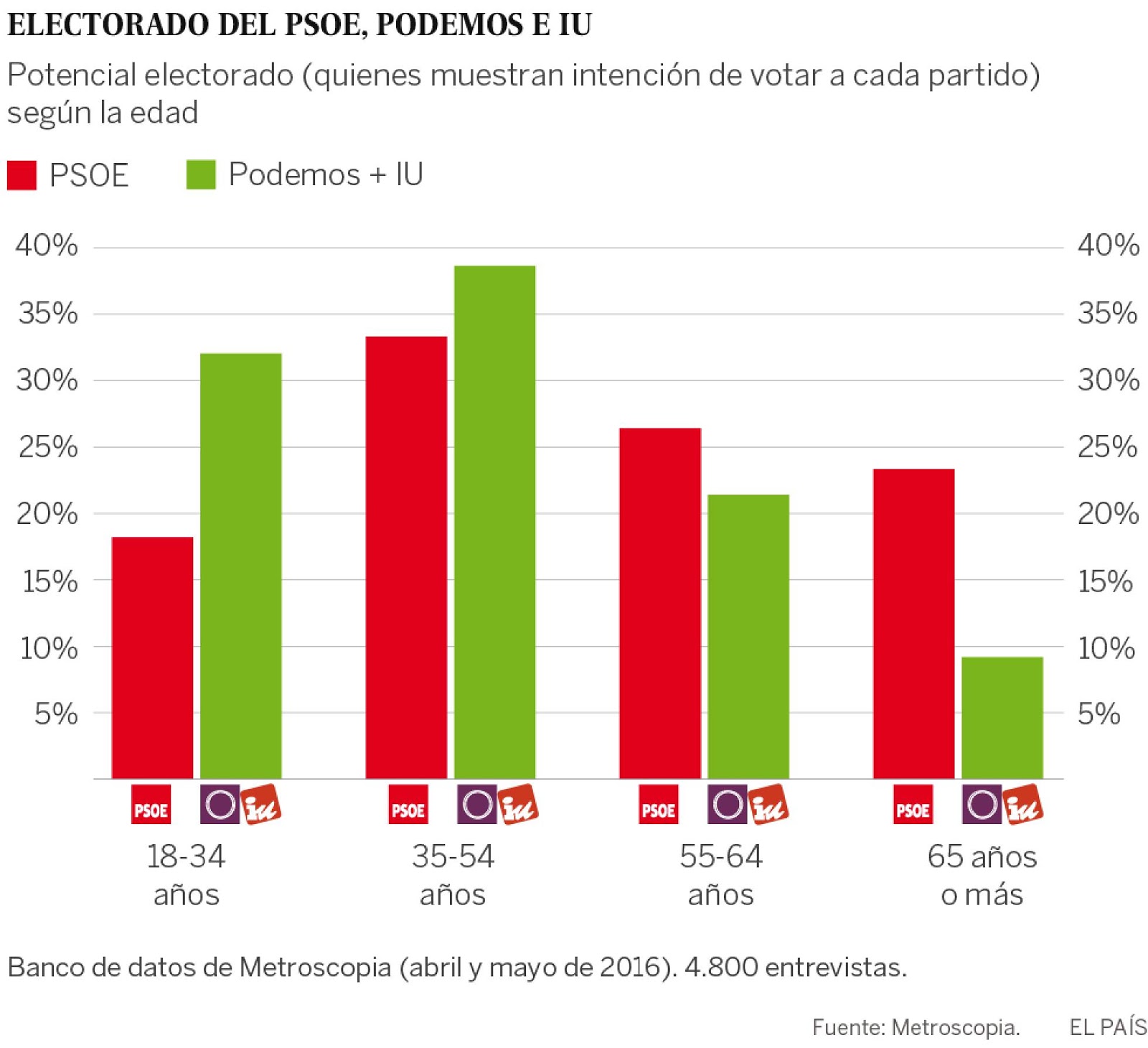
EL PAÍS.- Un estudio de Metroscopia demuestra que la alianza de izquierdas ya ha conquistado a los electores jóvenes y que el partido socialista mantiene un dominio incontestable entre los mayores de 55 años. La batalla del 26-J, en consecuencia, se disputará entre los votantes de mediana edad.Más...
Subscriure's a:
Missatges (Atom)