divendres, 18 de novembre del 2016

El 'no' a la independencia ganaría otra vez en Cataluña pero por mínimos


El rechazo a la independencia crece en Cataluña y esta opción ganaría por la mínima en caso de celebrarse un referéndum soberanista en esa comunidad. Así se desprende del último barómetro de la Generalitat que se ha publicado este viernes. El 44,9% de los catalanes votarían sí y el 45,1% votarían no. Según la misma encuesta, la primera que hace la Generalitat desde que su presidente, Carles Puigdemont, anunció un nuevo referéndum para septiembre, revela que Junts pel Sí volvería a ganar las elecciones. En la anterior encuesta, realizada en julio, el sí a la independencia había subido hasta el 47,7%, y el no se quedaba en un 42,4%.
(...)
Si se tienen en cuenta los datos sin cocinar, la intención de voto de Junts pel Sí continúa cayendo y, además, es la fuerza política catalana que lo hace con mayor fuerza. Según el último barómetro del Centro de Estudios de Opinión (CEO), la intención de voto directa hacia la coalición formada por el Partit Demòcrata Català Europeu (PDECat) y Esquerra Republicana (ERC) se reduciría al 30,3%, casi cuatro puntos menos que la última encuesta realizada por este organismo que depende de la Generalitat (34,1%), lo que da muestras de su "erosión", según ha señalado el director del CEO, Jordi Argelaguet.

En paralelo a la caída de Junts pel Sí, las encuestas muestran también una pérdida de intención de voto para su muleta parlamentaria, la CUP, que pasa del 5% de intención de voto de la última oleada del barómetro a un 4,5%.

El grueso de las formaciones con representación parlamentaria en Cataluña reducen su apoyo. Ciudadanos, la segunda fuerza con mayor representación en la Cámara catalana, pierde un escaso 0,2%, al pasar del 5,7% al 5,5%, Catalunya Sí que es Pot se queda en el 15,3% (frente al 16,6% anterior). El PSC se mantiene en el 10,3% (10,2% hace tres meses) y el PP saltaría del 3,5% al 4%. El gran aumento se produce en el capítulo de indecisos, que pasa de representar el 9,7% a ser ahora de un 12,5%, mientras que también crecería el número de personas que no votarían.
Seguir leyendo...


Los tres redactados que se barajan para el artículo 1 de la ‘Ley de Desconexión de Catalunya’
Este primer articulo definirá que es el Parlament de Catalunya quien declara la independencia. Y es aquí donde radica el debate político, técnico y semántico que los ponentes llevan entre manos. Una primera propuesta señala que Catalunya se define como un “Estado”, es decir, se reconoce su propia soberanía para ser un “ente estatal propio”. El principal argumento a favor de esta opción que se esgrime en los documentos de los diputados es que deja abierta la forma jurídica del futuro estado al proceso constituyente, que precisamente debe regular la misma ley de Règim Jurídic Català.

Una segunda propuesta se limita a describir que el Parlament declara Catalunya como una “República”. Los defensores de esta opción entienden que esta fórmula va al grano, puesto que ya define el “ente estatal soberano con una forma jurídica y política determinada, la republicana”. Asimismo, entre el argumentario de esta propuesta se incluye el “simbolismo ideológico del término república, que imbrica una serie de valores que se quieren identificar con el proceso independentista”. “Hablar de república es un término con el que puede empatizar mucha más gente”, añaden.

Una tercera opción implica un combinado en el que apareciera el concepto “república y Estado independiente”, de modo que neutralizara las dos posturas. “Es un debate jurídico técnico que tenemos que resolver”, apuntan fuentes de la ponencia que tampoco muestran excesiva preocupación por este debate.
Más...


Tarradellas: 'Cataluña es una dictadura blanca'

Vía Arcadi Espada

'El apoyo al populismo en toda Europa es probable que sea de corta duración'


Lord Kerr of Kinlochard, a British peer who has served as an ambassador both to the EU and US and also authored Article 50, said the threat posed by populism was not as large as some commentators have claimed. "I believe that the next French president is Alain Juppé (not Marine Le Pen). I think the next German chancellor is Angela Merkel. I don't think what we've seen is going to sweep across these countries.

In France, far-right party Front National is currently the second-most popular party ahead of May's presidential election, while in Germany, anti-immigration party Alternative for Germany (AfD) finished ahead of Merkel's Christian Democrats in some regional elections earlier this year.

Lord Kerr added, though, that the recent growth in support for right-wing groups across Europe will likely be short-lived, rather than the start of a shift in political culture across the west.

"It looks as if crises that are in their origin financial are blamed on the establishment and from there there's a kick to the right," he said. "But studies show this initial kick to the right effect fades after five to seven years."

[Inequality] will not be cured by leaving the EU. It will get worse if we leave the EU The Brexit vote, he said, was at least partly a result of Brits feeling ignored by the political establishment and economically left behind.

"But inequality has nothing to do with the EU," he added. "It will not be cured by leaving the EU. It will get worse if we leave the EU."

Also on the subject of Brexit, Lord Kerr said national debate around issues like immigration has become overwhelmed by emotion at the expense of evidence, claiming immigration is needed to keep the country "running."

Lord Kerr was on the panel with former government advisor Rachel Woolf and journalist Professor Daine Roberts to discuss how populism, particularly Trump's shock victory, will change policy-making in western democracies.

Reflecting on Trump's victory over Hillary Clinton, Lord Kerr dismissed the popular theory that the economy and in particular inequality was the primary reason why voters backed the Republican candidate.

"The median income of the Trump voter was a lot higher than that of the Clinton voter. I'm not sure if it was about the economy." he said.
Más...


dijous, 17 de novembre del 2016

Trump como oportunidad


Mientras esperamos a que los sabios se pongan de acuerdo sobre las causas de la victoria de Donald Trump -si han sido los perdedores de la globalización, los revanchistas supremacistas de la nación blanca, los hastiados de la mojigatería de la corrección política, los desilusionados con Obama y los que nunca creyeron en él, o por todas esas razones y en qué proporción cada una de ellas- podemos intentar dilucidar algunas de las posibles oportunidades que ofrece su ascenso a la Casa Blanca.

Si nos atenemos a lo literal de su programa económico, Trump intentará poner en práctica una política proteccionista, modificando sustancialmente los acuerdos de libre comercio firmados por los Estados Unidos o, si ello no es posible, abandonando los mismos. Sin embargo, no está claro que pueda hacerlo fácilmente, ya que contará con la oposición de los demócratas y, lo que es decisivo, de gran parte de los republicanos, que han sido y siguen siendo firmes defensores del libre comercio internacional.

Por lo que respecta a la inmigración ilegal, más de lo mismo. Tras su victoria electoral, Trump matizó ya sus propuestas: dijo que expulsaría entre 2,5 y 3 millones de ilegales con antecedentes penales y que respecto a la frontera con México quién dice muro, dice valla. Si eso es así, nos encontraríamos con una política no muy diferente a la que ha aplicado Obama, que es el presidente que más inmigrantes ha deportado bajo su mandato. Un total de 2.571.860 personas, hasta julio de 2016. La diferencia sería en que mientras la administración Obama lo disimula de manera vergonzante, la administración Trump lo publicitará de  manera descarada.

Por lo que respecta al orden político internacional, garantizado por la 'pax americana' por lo menos hasta que Obama llegó a la presidencia, la tentación aislacionista será relativa ya que casi cualquier conflicto internacional puede lesionar o perjudicar los intereses nacionales de Estados Unidos. Incluso su desprecio por Europa -vividores que se permiten todos los lujos gracias al dinero americano que garantiza su defensa- y su afinidad con Putin, puede ser un mal que por bien no venga, siempre y cuando haga reaccionar a los europeos.

De momento, parece que las cosas han empezado a moverse. El ex primer ministro belga, líder de los liberales europeos y coordinador por el Parlamento Europeo de los negociadores del Brexit, Guy Verhofstadt, lo ha dicho claro:

La UE debería ver la elección de Trump como una llamada de atención para hacerse cargo de su propio destino. Los conflictos actuales, como la sangrienta guerra civil en Siria y la anexión de Crimea por parte de Rusia, así como su intervención en Ucrania del Este, afectan directamente la seguridad, las economías y las sociedades de los estados miembro de la UE. Y sin embargo, hasta ahora los rusos y los estadounidenses, en lugar de los europeos, han determinado el destino de Ucrania y el de otros países fronterizos de Europa. Como resultado, la UE ha renunciado al control último de su propia seguridad, sus relaciones comerciales y sus flujos migratorios.

(...)

Por esta razón la UE no puede seguir postergando la creación de su propia Comunidad Europea de Defensa y desarrollar su estrategia de seguridad. Debería comenzar por simplificar y ampliar sus relaciones bilaterales y regionales, no en menor medida entre los países escandinavos y bálticos, así como entre Bélgica y Holanda, y Alemania y Francia. Todas estas relaciones dispares se deben unir bajo un solo comando europeo que reciba financiación y un sistema de adquisiciones de defensa común.

La UE debe volverse capaz de protegerse a sí misma, o no podrá garantizar la integridad de su territorio. Se trata de una decisión difícil pero vital que ha pospuesto por demasiado tiempo. Ahora que Trump ha sido electo, ya no puede esperar más.

Por otro lado, Verhofstadt propone un plan de 6 puntos para alcanzar la plena integración europea:

1. Crear un Gobierno de la UE y un presidente

2. Establecer un FBI europeo en Bruselas

3. Crear un ejército europeo

4. Establecer una Hacienda o Tesoro europeo también en Bruselas

5. Completar el mercado único de servicios digitales

6. Acabar con las cláusulas de exención de Schengen y el euro

En este sentido, los ministros de asuntos exteriores de Francia y Alemania, Jean-Marc Ayrault y Frank-Walter Steinmeier, en un documento de 9 páginas desentierran la 'Europa a dos velocidades' para crear una nueva unión conformada por lo menos por Francia, Alemania y los países del Benelux (Bélgica, Holanda y Luxemburgo) con plena integración fiscal, una política monetaria propia y un departamento del Tesoro con sede en Bruselas e independiente del Banco Central Europeo para adoptar todas las decisiones económicas.

Trump y el Brexit están provocando, pues, una necesaria reacción europeísta, pero no sabemos si suficiente para contrarestar el crecimiento del nacionalismo y el populismo. Sin embargo, hemos de agradecer a Trump y a Farage esta oportunidad. Oportunidad que también el mundo puede aprovechar en otros órdenes, ya sea en los interminables conflictos en Oriente Medio, la amenaza nuclear de Irán, el peligro jihadista o la desmesura política y financiera respecto al calentamiento global.

Por lo que se refiere a los musulmanes, el desplome de la influencia de EEUU en Oriente Medio durante los ocho años de la Administración Obama hace que la única posibilidad ahora sea mejorar. Por otro lado, la medida -polémica y muy difícil de aplicar- de prohibir la entrada de musulmanes a los Estados Unidos no debe ser vista como una postura racista, sino como una medida de endurecimiento en la lucha contra el ISIS y el yihadismo, lucha que comparten muchos musulmanes y la mayoría de sus gobiernos. Por otro lado, su crítica del acuerdo nuclear de EEUU con Irán es también compartido por la mayoría de gobiernos árabes de la región. Acuerdo cuyo desguace puede no ser tan complicado como parece, atendiendo a las constantes violaciones del mismo por parte de Teherán. Todo lo que tiene que ocurrir para que el acuerdo se desmorone es que Trump haga lo que el gobierno de Obama se ha negado a realizar: hacer cumplir sus disposiciones.

Finalmente, Trump puede ser la oportunidad para desactivar ese monstruo de despilfarro y mala ciencia que son los programas de la ONU para reducir y suprimir las emisiones de CO2. En palabras de la climatóloga estadounidense Judith Curry, que cree que las consecuencias del calentamiento global son inciertas y exageradas, la presidencia de Trump puede dar una oportunidad para una política de energía y clima más racional:
  • Una revision de la ciencia del clima que incluya de forma leal y transparente las incertidumbres sobre las proyecciones del cambio climático del clima global y regional.
  • Reabrir la cuestión de si el calentamiento es “preocupante”.
  • Rehacer las estimaciones del coste social del CO2, incluyendo toda la incertidumbre de los modelos climáticos, una estimación integrada de los modelos y sus “inputs”.
  • Financiar sistemas de observación de la tierra (satélites, superficie, océano) y la investigación del cambio climático natural.

Trump ha despertado, comprensiblemente, miedo y preocupación. Pero está ahí y ocupará la presidencia, por lo menos, durante cuatro años. Y probablemente ocho, si no hay impeachment. Lo más sensato, pues, es tomarnos a Trump como oportunidad para evitar o paliar los males que representa.

Apertura de la XII Legislatura de las Cortes Generales

dimecres, 16 de novembre del 2016

La moneda de Colau o 'ralet, ralet, ¡pica dineret!'

Salida directamente de la guardería municipal en la que se ha convertido el gobierno de Barcelona, la 'senyu' Colau anuncia la creación de una moneda local para que los nens y nenes puedan jugar a botiguetes con un dinero sin valor inventado por y para los políticos que, no satisfechos con meterte la mano en el bolsillo con los impuestos, ahora quieren decirte cómo y dónde gastarte el dinero que te queda. 'Ralet, ralet, ¡paga dineret!'

El riesgo de estos instrumentos está precisamente en que lo garantiza una corporación local que no tiene legitimidad ni estatal ni europea, ni reconocida por el BCE, ni tampoco –ojo- de sus propios ciudadanos para emitir moneda y menos garantizarla con un valor 1 a 1 equivalente a la moneda de curso legal. Como ocurrió en tantos países, esa paridad artificial está “garantizada” por nada más que la promesa del gobierno local, que no tiene soberanía ni presupuestaria ni recaudatoria, ni mucho menos capacidad de respaldarla con activos reales.

Por lo tanto, no es una moneda sino un IOU, una promesa de pago diferida. Y su valor se desploma en el momento en el que caiga el velo de la paridad inventada –sea a través de un mecanismo de regularización de cuentas o simplemente porque los ciudadanos no aceptan esa paridad como real-.

El segundo problema es ideológico. Incluso si el consistorio solo emite monedas respaldadas por los euros, dólares u oro del que disponga en sus cofres –si los tiene-, obliga a los ciudadanos y comercios a utilizarla asignando unilateralmente los negocios o comercios en los que se puede utilizar. Por un lado esas monedas te queman en el bolsillo porque se “funden” si no consumes, y por otro lado el consistorio decide unilateralmente dónde te las debes gastar.

¿A qué lleva esto? A una asignación artificial e ineficiente de una demanda orientada políticamente. ¿En qué sectores suele recaer? No es para el lector una sorpresa dónde suele recaer el “favor” de dirigir políticamente el consumo de la renta disponible de los funcionarios públicos. En sectores políticamente afines, rentistas y que ya estaban cerca de desaparecer por obsolescencia y competencia.

Es decir, se usa una moneda sin respaldo real para subvencionar políticamente a sectores predefinidos y con ello se retrasa el cambio de patrón de crecimiento y se perpetúan desequilibrios. En el caso de Tauschkreis en Austria, los negocios reconocen que no pueden aceptar ese experimento por el nivel de endeudamiento que conlleva.Y es que ahí está el mayor problema.

La emisión de moneda local –cuyo control es exclusivamente político y su respaldo difícilmente auditable – se usa para disfrazar aumentos de gasto y de deuda. En el caso de Barcelona, por ejemplo, no ocultan algunos economistas que es “una forma de superar el límite de gasto e invertir en proyectos sociales”. Es decir, emitir moneda que en realidad es una deuda contraída y no respaldada para gastarla en proyectos sin rentabilidad económica real que reducen la capacidad de repago de los compromisos crediticios adquiridos. Esconder deuda llamándolo moneda.| DANIEL LACALLE
Más...

Josep Pla y la moneda


dimarts, 15 de novembre del 2016

¿Será Trump peor que Obama?


Veremos periodistas “incómodos” espiados y acosados por investigar abusos del gobierno. Y denunciados en secreto, mediante leyes semi-secretas de poco o ningún control judicial real. Una pesadilla democrática.

Veremos acciones bélicas continuadas del ejército USA que, por ser sin una declaración de guerra, serán llevadas a cabo sin tomarse la molestia de pedir la preceptiva conformidad del Congreso.

Veremos ordenar y llevar a cabo asesinatos con una lista de asesinables, en cientos de acciones e incluyendo a ciudadanos americanos. También sin declaración de guerra, ni ninguna posibilidad de control judicial posterior. Vaya, sin responsabilidad, ni Congreso, ni vainas. Mayormente mediante drones.

Veremos un espionaje masivo de los ciudadanos americanos (del resto no hablemos), también sin ningún control. Bueno, un control llevado a cabo por jueces secretos, y vigilados por comités secretos que, muy en secreto, sólo responden ante Dios o la conciencia que tengan.

Y si a algún funcionario o contratado por la administración se le ocurre intentar denunciar al público estos abusos de poder, se le aplicarán las leyes de espionaje para encerrarlo en vida más o menos para siempre. Y probablemente este gobierno lleve a cabo más acciones de este tipo que la suma de todos los demás gobiernos de toda la historia de los Estados Unidos.

Como todo el mundo sabe que los congresistas y senadores son una panda gilipollas que sólo viven para estorbar, veremos también un récord de gobierno mediante órdenes ejecutivas (no leyes), y mediante ordenanzas de las distintas agencias de la administración. Y la firma de tratados internacionales sin la preceptiva autorización del Senado, bajo la disculpa de que no son vinculantes — pero luego resulta que eran totalmente vinculantes.

Esto que acaban de leer es lo que mucha gente teme que hará Trump cuando sea formalmente presidente de los Estados Unidos. Y, ciertamente, lo más probable es que lo haga. La paradoja, sin embargo, es que todo eso ya lo ha hecho el todavía inquilino de la Casa Blanca, Barack Obama, sin que casi nadie haya puesto el grito en el cielo o se haya rasgado las vestiduras. Obama sigue siendo a los ojos de casi todo el mundo un dechado de virtudes, como su premio Nobel de la Paz nos recuerda. Y es que no hay nada como nacer con la flor- y la pleitesía mediática- en el culo.


Recogen firmas para que el Colegio Electoral elija a Hillary Clinton como presidenta de los Estados Unidos al haber obtenido más votos que Donald Trump


Los que no aceptan la victoria de Donald Trump -que ha sido elegido con las leyes y costumbres electorales con que fueron elegidos Barak Obama y sus antecesores- han puesto en marcha una recogida de firmas para impedir que llegue a la Casa Blanca y lo haga en su lugar Hillary Clinton.

Si bien los electores que componen el Colegio Electoral de EEUU son técnicamente libres de votar a favor de cualquier persona elegible para ser presidente, en la práctica se comprometen a votar por candidatos específicos. Y así ha sido siempre. Para evitar el voto tránsfuga, veintinueve estados más el Distrito de Columbia tienen leyes para castigarlo.

En 1952, la constitucionalidad de estas leyes estatales fue llevada ante el Tribunal Supremo (Ray_v._Blair). El Tribunal falló a favor de las leyes estatales que requieren electores que se comprometan a votar por el candidato ganador, así como a destituir a aquellos que no lo acepten. Como se afirma en el fallo, los electores están actuando como funcionarios del estado.

Ahora, los que se consideran moralmente superiores, incluido este sabio que sin duda es Steven Pinker, llaman a que el Colegio Electoral se salte la legalidad y quite la presidencia a Trump y la entregue a Clinton. De esta manera, Pinker y muchos 'liberales' americanos se sitúan a la altura, por ejemplo, de Artur Mas, ese iluminado que desobedece la Ley por qué obedece al pueblo.

dilluns, 14 de novembre del 2016

El momento de máxima racionalidad de la política española cumple 40 años este 18 de noviembre

Las Cortes franquistas se hacen el harakiri y aprueban la Ley para la Reforma Política


Culmina el debate. Adolfo Suárez, en su escaño azul, cierra los ojos y echa lentamente la cabeza hacia atrás. Su gesto de emoción contenida simboliza el momento de máxima racionalidad de la política española. Y es profundamente conmovedor. La reforma se impuso al búnker pero también al adanismo y la ruptura. Y España dio una lección al mundo que hoy el mundo y España parecen haber olvidado. Entonces unos pocos hombres buenos dominaron los instintos propios y ajenos para restaurar la democracia.

Ahora una generación de histéricos pretende embridar la democracia para restaurar el instinto. El nuevo populismo plantea una pregunta que creíamos contestada: ¿qué es la democracia? Y sentencia con letal ligereza: es la voluntad del pueblo, incluso contra las leyes, las instituciones y los jueces. Estados Unidos ha pasado de la ultracorrección política al culto ultra a la incorrección. Ya tiene su primer presidente iconoclasta, un hombre que ha hecho de las vísceras el motor de su campaña. En Gran Bretaña, ocho siglos y un año después de Magna Carta, tres jueces son agredidos por recordar lo obvio: que el Gobierno está sometido a las leyes, que el aval directo del pueblo no sustituye el aval constitucional del Parlamento, que no hay democracia sin reglas. La prensa los ridiculiza; los llama europeístas (!); señala y proclama, oh, que uno es gay. Y cuando la sensatez reacciona, el Gobierno -del partido de Churchill y Thatcher- defiende a la jauría y recurre a la Corte Suprema.

Luego esta foto de Trump y Farage: la cruda paradoja de que las dos naciones que hace un siglo salvaron a Europa de la fuerza devastadora de la irracionalidad sean hoy las que la lideran. España va detrás. Aquí, podémicos y separatistas invocan a la «gente» para plantear una nueva ruptura. Enarbolan la democracia directa contra la democracia representativa. Atacan a la justicia. Ayer otra vez. Asaltan el Congreso desde la tribuna y la barrera. Y, en un movimiento de trileros, impugnan el primer derecho político de la «gente», su soberanía. En esto se revelan como lo que son: el nuevo búnker. La Ley para la Reforma Política no decretó la democracia. Devolvió a los españoles, a todos ellos, su derecho a decidir. Puigdemont, Otegi, Iglesias, Colau... representan una regresión, no ya respecto de la Constitución de 1978, sino del último franquismo. Son la más feroz reacción. | CAYETANA ÁLVAREZ DE TOLEDO
Seguir leyendo...


La última entrevista (Septiembre 2016) The New Yorker


OPEN CULTURE.- We’ve heard very few details about Leonard Cohen’s death this week, and that is by design. The Cohen family requested privacy for his funeral and received it. While most outlets reported that he passed away on Thursday night, he actually died on Wednesday and was buried on Thursday. This collective graciousness on the part of the press comes, I’d say, at a time when little grace abounds. Grace is a word that I particularly associate with Cohen. He was a graceful man, always impeccably coiffed and dressed (his father was a tailor), his handsome, hangdog face never anything but perfectly direct.

For several days before his death, New Yorker editor David Remnick sat down with Cohen for the first interview he’d given in several years. The poet and folk singer/songwriter legend had terminal cancer, we learn, and was confined to a medical chair. Nonetheless, says Remnick, introducing the edited audio interview above, Cohen was “in an ebullient mood for a man… who knew exactly where he was going, and he was headed there in a hurry. And at the same time, he was incredibly gracious. The most gracious host this side of my mother.” Cut to Cohen offering him a few slices of cheese, and Reminick declining.

Cohen kept his illness secret (though he made allusions to it in a letter to his dying girlfriend Marianne this past summer). Remnick reveals that he recorded almost the entirety of his incredible final album You Want It Darker while confined to that chair. His voice rubbed raw with age, like Johnny Cash’s in his American Recordings sessions, Cohen’s last songs carry all the spiritual urgency and ragged vigor of the best work of his career. Where did it come from? Unsurprisingly, the first subject in Remnick’s interview is death. Cohen has been writing about death since his first album in 1967.
Seguir leyendo...

diumenge, 13 de novembre del 2016

No todas las encuestas erraron

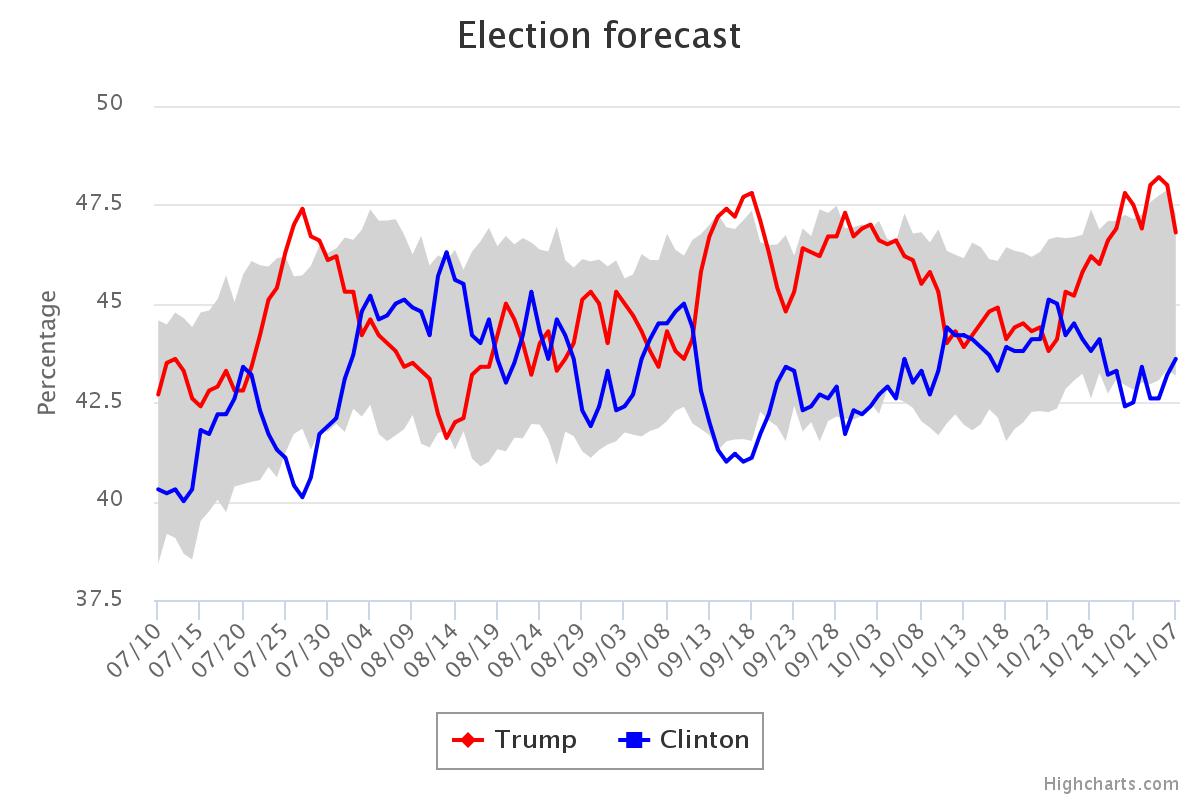
Es cierto que la mayor parte de las encuestas erraron sus pronósticos sobre quién ganaría la elección presidencial en los Estados Unidos. Pero no todas. Varios observatorios de opinión pública, entre ellos algunos de distintas Universidades americanas y ciertas empresas de larga y solvente trayectoria, apuntaron a una posible victoria de Trump o, en todo caso, mostraron que la batalla electoral era muy reñida y que en ningún caso Clinton la tenía ganada de antemano. Pero tal vez quién más acertó fue el periódico liberal Los Ángeles Times que en su seguimiento diario de la larga campaña presidencial evidenciaba la probabilidad delna victoria de Trump, como se puede comprobar en el siguiente gráfico:


Sin embargo, la práctica totalidad de los medios de información estadounidenses y europeos ignoraron esas encuestas y solo difundieron las que apuntaban a una victoria de la candidata demócrata. Encuestas realizadas para los grandes medios de comunicación, con un sesgo editorial explícito en contra de Trump. Así, se publicaron reiteradamente cosas como esta:


El problema de este gran error no radica en los grandes medios, de los cuales todo el mundo sabe su posicionamiento político e ideológico, sino en los científicos sociales, mayoritariamente escorados a la izquierda.

QUILLETTE.- When scientists blame the world for not conforming to their models, rather than the other way around, something is wrong. But why do people who consider themselves scientists not adhere to basic scientific methodology?

The reason, I suggest, is that the social sciences have fostered an environment where certain beliefs are held above scientific inquiry, thus making them unchallengeable. Consequently, scientists are unable to adjust their models of human behaviour when they make poor predictions, forcing the scientists instead into a position of surprise, perplexity, and moral condemnation.

Consider the values Trump has been promoting throughout his campaign. When he promises to make America great again and complains that America doesn’t win anymore, when he promises to reduce government, when he aggressively goes after his opponents, and when he refuses to couch his words in equivocation, he is not just offering a new political direction, he is thumbing his nose at contemporary moral beliefs, and many people are responding to it, especially men.

People have been taught for years that traits such as competitiveness, individualism, aggression, confidence, and national pride are morally suspect, and here comes a figure who is unafraid to challenge that. I’ve heard mentioned that Trump is tapping into many people’s disdain for political correctness, but that’s just the tip of the iceberg, in my opinion. I think he’s tapping into a broad resistance to contemporary moral beliefs, beliefs that have become increasingly institutionalised over the past fifty years.

The problem is that these are precisely the beliefs that are held above inquiry in the social sciences. Under normal scientific conditions, scientists would simply say ‘oh, it looks like we underestimated the extent to which these values are drivers of human behaviour, let us adjust our models’. But social scientists can’t do that, so all they can do is declare them immoral, whether it be Brexit, or Trump, or the movements in France and Germany and many other Western countries that are currently building.

It isn’t just that social scientists disagree on the details of how important this behaviour is to people, but that even discussing it in anything other than strongly moralistic terms is discouraged. And so, social scientists face a dilemma. Treating individualism, competitiveness, confidence, aggression, and national pride as behaviour worthy of description dilutes the power of ideologies to moralise against them. And this threatens the left, which dominates the social sciences and whose ideology is based on declaring these behaviours immoral. It’s hard for social scientists in this environment to remain objective, and since there are virtually no social scientists with opposing views, the science suffers. | Uri Harris
Leer más...

dissabte, 12 de novembre del 2016

divendres, 11 de novembre del 2016

Cohen se va, bailando hasta el fin del amor


El discurso de Leonard Cohen al recoger el Príncipe de Asturias de las Letras en 2011

Texto íntegro del discurso, aquí


La esperanza es que la elección de Trump resulte catártica


The hope is that this election will prove cathartic. Perhaps, in office, Mr Trump will be pragmatic and magnanimous—as he was in his acceptance speech. Perhaps he will be King Donald, a figurehead and tweeter-in-chief who presides over an executive vice-president and a cabinet of competent, reasonable people. When he decides against building a wall against Mexico after all or concludes that a trade war with China is not a wise idea, his voters may not mind too much—because they only expected him to make them feel proud and to put conservative justices in the Supreme Court. Indeed, you can just about imagine a future in which extra infrastructure spending, combined with deregulation, tax cuts, a stronger dollar and the repatriation of corporate profits, boosts the American economy for long enough to pacify the anger. This more emollient Trump might even model himself on Ronald Reagan, a conservative hero who was mocked and underestimated, too.

Nothing would make us happier than to see Mr Trump succeed in this way. But whereas Reagan was an optimist, Mr Trump rails against the loss of an imagined past. We are deeply sceptical that he will make a good president—because of his policies, his temperament and the demands of political office.

(...)

The genius of America’s constitution is to limit the harm one president can do. We hope Mr Trump proves our doubts groundless or that, if he fails, a better president will be along in four years. The danger with popular anger, though, is that disillusion with Mr Trump will only add to the discontent that put him there in the first place. If so, his failure would pave the way for someone even more bent on breaking the system.

The election of Mr Trump is a rebuff to all liberals, including this newspaper. The open markets and classically liberal democracy that we defend, and which had seemed to be affirmed in 1989, have been rejected by the electorate first in Britain and now in America. France, Italy and other European countries may well follow. It is clear that popular support for the Western order depended more on rapid growth and the galvanising effect of the Soviet threat than on intellectual conviction. Recently Western democracies have done too little to spread the benefits of prosperity. Politicians and pundits took the acquiescence of the disillusioned for granted. As Mr Trump prepares to enter the White House, the long, hard job of winning the argument for liberal internationalism begins anew.
THE ECONOMIST


FT.- The manner of Trump’s victory lays bare the social basis of the movement he has mobilised. A look at the voting map shows Clinton’s support concentrated geographically in cities along the coasts, with swaths of rural and small-town America voting solidly for Trump. The most surprising shifts were his flipping of Pennsylvania, Michigan and Wisconsin, three northern industrial states that were so solidly Democratic in recent elections that Clinton didn’t even bother to campaign in the latter one. He won by being able to win over unionised workers who had been hit by deindustrialisation, promising to “make America great again” by restoring their lost manufacturing jobs.

We have seen this story before. This is the story of Brexit, where the pro-Leave vote was similarly concentrated in rural areas and small towns and cities outside London. It is also true in France, where working-class voters whose parents and grandparents used to vote for the Communist or Socialist parties are voting for Marine Le Pen’s National Front.

But populist nationalism is a far broader phenomenon than that. Vladimir Putin remains unpopular among more educated voters in big cities such as St Petersburg and Moscow, but has a huge support base in the rest of the country. The same is true of Turkey’s president Recep Tayyip Erdogan, who has an enthusiastic support base among the country’s conservative lower middle class, or Hungary’s prime minister Viktor Orban, who is popular everywhere but in Budapest.

Social class, defined today by one’s level of education, appears to have become the single most important social fracture in countless industrialised and emerging-market countries. This, in turn, is driven directly by globalisation and the march of technology, which has been facilitated in turn by the liberal world order created largely by the US since 1945.

When we talk about a liberal world order, we are speaking about the rules-based system of international trade and investment that has fuelled global growth in recent years. This is the system that allows iPhones to be assembled in China and shipped to customers in the US or Europe in the week before Christmas. It has also facilitated the movement of millions of people from poorer countries to richer ones, where they can find greater opportunities for themselves and their children. This system has worked as advertised: between 1970 and the US financial crisis of 2008, global output of goods and services quadrupled, bringing hundreds of millions of people out of poverty, not just in China and India but in Latin America and sub-Saharan Africa.

But as everyone is painfully aware now, the benefits of this system did not filter down to the whole population. The working classes in the developed world saw their jobs disappear as companies outsourced and squeezed efficiencies in response to a ruthlessly competitive global market.

This long-term story was hugely exacerbated by the US subprime crisis of 2008, and the euro crisis that hit Europe a couple of years later. In both cases, systems designed by elites — liberalised financial markets in the US case, and European policies such as the euro and the Schengen system of internal migration — collapsed dramatically in the face of external shocks. The costs of these failures were again much more heavily borne by ordinary workers than by the elites themselves. Ever since, the real question should not have been why populism has emerged in 2016, but why it took so long to become manifest.

In the US, there was a political failure insofar as the system did not adequately represent the traditional working class. The Republican party was dominated by corporate America and its allies who had profited handsomely from globalisation, while the Democratic party had become the party of identity politics: a coalition of women, African-Americans, Hispanics, environmentalists, and the LGBT community, that lost its focus on economic issues.

The failure of the American left to represent the working class is mirrored in similar failures across Europe. European social democracy had made its peace with globalisation a couple of decades ago, in the form of Blairite centrism or the kind of neoliberal reformism engineered by Gerhard Schröder’s Social Democrats in the 2000s.

But the broader failure of the left was the same one made in the lead-up to 1914 and the Great war, when, in the apt phrase of the British-Czech philosopher, Ernest Gellner, a letter sent to a mailbox marked “class” was mistakenly delivered to one marked “nation.” Nation almost always trumps class because it is able to tap into a powerful source of identity, the desire to connect with an organic cultural community. This longing for identity is now emerging in the form of the American alt-right, a formerly ostracised collection of groups espousing white nationalism in one form or another. But even short of these extremists, many ordinary American citizens began to wonder why their communities were filling up with immigrants, and who had authorised a system of politically correct language by which one could not even complain about the problem. This is why Donald Trump received a huge number of votes from better-educated and more well-off voters as well, who were not victims of globalisation but still felt their country was being taken from them. Needless to say, this dynamic underlay the Brexit vote as well.

So what will be the concrete consequences of the Trump victory for the international system? Contrary to his critics, Trump does have a consistent and thought-through position: he is a nationalist on economic policy, and in relation to the global political system. He has clearly stated that he will seek to renegotiate existing trade agreements such as Nafta and presumably the WTO, and if he doesn’t get what he wants, he is willing to contemplate exiting from them. And he has expressed admiration for “strong” leaders such as Russia’s Putin who nonetheless get results through decisive action. He is correspondingly much less enamoured of traditional US allies such as those in Nato, or Japan and South Korea, whom he has accused of freeriding on American power. This suggests that support for them will also be conditional on a renegotiation of the cost-sharing arrangements now in place. | Francis Fukuyama


WSJ.- For decades, progressives have emphasized the “income gap” separating rich and poor. Their cries have only grown louder since the financial crisis. They contended that income inequality would ignite a new class struggle, causing unprecedented political turmoil.

This was half right. There is indeed a gap in this country, and it has now led to a political revolution, a significant realignment in American politics. But the relevant gap wasn’t income. It was dignity.

Too many Americans have lost pride in themselves. We sense dignity by creating value with our lives, through families, communities, and especially work. That is why American leaders so frequently talk about dignity in the context of labor. As Martin Luther King Jr. taught, “All labor that uplifts humanity has dignity and importance and should be undertaken with painstaking excellence.” Conversely, nothing destroys dignity more than idleness and a sense of superfluousness—the feeling that one is simply not needed.

That is the circumstance in which millions of Americans find themselves today. Best-selling books over the past few years such as Charles Murray’s “Coming Apart” and J.D. Vance’s “Hillbilly Elegy” tell the story. The U.S. is bifurcating into a nation of economic winners and losers, and this distinction is seeping into American culture. The dignity gap grows every time those who lose out start hearing, “We don’t need you anymore.”

Who falls on the wrong side of this dignity gap? These days it is working-class men. In his new book “Men Without Work,” my colleague Nick Eberstadt shows that between 1965 and 2015 the percentage of working-aged men outside the workforce increased to 22% from 10%. Many millions more are underemployed. The employment-to-population ratio for men aged 25-54 is 6.8% lower today than it was in 1930, in the teeth of the Great Depression.

These secular trends were amplified by the nonrecovery that most Americans experienced after the Great Recession. Only about the top fifth of the economy saw positive income growth for most of the Obama presidency, Census Bureau data show, while most others averaged no growth at all. This stagnation has decimated middle-aged men without a college education, especially in rural areas.

Men without work are much less likely than working men to be married with families, Mr. Eberstadt also shows, further compounding the problem. Does modern society tell many working-class men they are needed and valued as husbands and fathers? This question answers itself.

Life without dignity can produce shocking results. In a 2015 paper, Princeton economists Anne Case and Angus Deaton showed that the mortality rates of middle-aged American whites have actually increased since 1999. They are the only demographic group for whom this is true. The main reasons? Cirrhosis of the liver (up 50% since 1999 among this group), suicide (up 78%), and poisonings due to drugs and alcohol (up 323%). These trends are mostly driven by those with less education.| ARTHUR C. BROOKS


THE GUARDIAN.- Some scientists will have to join the White House itself. When George W. Bush was elected, his administration had a hard time finding a scientist willing to serve as his science advisor. When Jack Marburger, a highly respected administrator and physicist who was also a Democrat, took the job he was excoriated by his peers and excommunicated from some scientific circles. We see hints of similar responses to Trump’s election already. Earlier this week the American Physical Society issued a press release congratulating Trump on his victory and encouraging him to “make sustained and robust funding of scientific research a top priority.” The APS received so many complaints that it felt compelled to retract it and issue an apology.

Some have already written off Trump’s yet-to-be-named science advisor. For instance, Robert Cook-Deegan of Arizona State University says, “For Trump, I’m not sure [his science advisor] would matter, because there won’t be any ‘policy’ apparatus… Science won’t get much attention, except when it gets in the way or bolsters support for a political priority.” Marburger was called a “prostitute” upon taking the position under Bush.

There are thousands of political appointees, including many science positions, that will need to be nominated, expert advisory bodies constituted and reconstituted, and experts put into staff positions under the White House. Any scientist who agrees to hold their nose and work with the Trump administration should expect much of the same criticism received by Marburger. Some, such as government scientists, will not have much choice but to engage. That is their job. | Jack Stilgoe & Roger Pielke Jr


dijous, 10 de novembre del 2016

Lo que Donald Trump quiere hacer en sus primeros 100 días

Este es el programa fascista -que digo fascista, requetefascista- de Donald Trump, como Uds mismos podrán comprobar a continuación. 


Enmienda constitucional para limitar los mandatos de todos los miembros del Congreso

Congelación de la contratación de empleados federales (excepto militares, seguridad pública y salud pública)

Por cada nueva regulación federal que se cree, dos regulaciones existentes deben ser eliminadas

Endurecer las limitaciones para ejercer el lobby de los ex cargos políticos

Sustituir la ley del sector financiero Dodd-Frank por políticas a favor del crecimiento. Los bancos podrán no sólo para participar de nuevo en el prop trading, sino también invertir directamente en los hedge funds 

Renegociar el NAFTA o salir del mismo por la vía del Artículo 2205, retirarse de la Asociación Trans Pacífico y calificar a China como estado manipulador de divisas

Identificar y acabar con todos los abusos del comercio exterior que impactan injustamente en los trabajadores estadounidenses

Levantar las restricciones a la producción de energía, incluyendo la producción de esquisto, petróleo, gas natural y carbón limpio

Cancelar miles de millones de los pagos a los programas de cambio climático de la ONU y utilizarlos en infraestructuras para el agua y el medio ambiente en EEUU

Cancelar todas las acciones ejecutivas, memorándums y órdenes inconstitucionales emitidas por Obama

Iniciar el proceso de selección del sustituto del juez Scalia de una lista de 20 jueces

Comenzar la repatriación de los más de 2 millones de inmigrantes ilegales

Suspender la inmigración desde regiones propensas al terrorismo

Reducción de impuestos:


  • Una familia de clase media con 2 niños obtendrá una reducción de impuestos del 35%
  • El número actual de tramos se reducirá de 7 a 3, y los formularios se simplificarán mucho
  • El tipo impositivo se reducirá del 35 a 15 %
  • El dinero de las empresas estadounidenses en el extranjero podrá volver a una tasa del 10 %


Establecer aranceles a los productos de las empresas que despidan a sus trabajadores y se deslocalizen

Derogar totalmente el Obamacare y reemplazarlo por cuentas de ahorro de salud

Permitir que el cuidado de niños y ancianos sea deducible de impuestos

Construcción de un muro en la frontera con México y establecer una pena mínima de 2 años de prisión para los inmigrantes que vuelvan a entrar ilegalmente en los EEUU

Proporcionar a los soldados veteranos tratamiento público en las Veterans Health Administration o asistir al médico privado de su elección


Texto completo en inglés de las 28 propuestas que Trump quiere implementar de inmediato

What follows is my 100-day action plan to Make America Great Again. It is a contract between myself and the American voter — and begins with restoring honesty, accountability and change to Washington

Therefore, on the first day of my term of office, my administration will immediately pursue the following six measures to clean up the corruption and special interest collusion in Washington, DC:

* FIRST, propose a Constitutional Amendment to impose term limits on all members of Congress;

* SECOND, a hiring freeze on all federal employees to reduce federal workforce through attrition (exempting military, public safety, and public health);

* THIRD, a requirement that for every new federal regulation, two existing regulations must be eliminated;

* FOURTH, a 5 year-ban on White House and Congressional officials becoming lobbyists after they leave government service;

* FIFTH, a lifetime ban on White House officials lobbying on behalf of a foreign government;

* SIXTH, a complete ban on foreign lobbyists raising money for American elections.

On the same day, I will begin taking the following 7 actions to protect American workers:

* FIRST, I will announce my intention to renegotiate NAFTA or withdraw from the deal under Article 2205

* SECOND, I will announce our withdrawal from the Trans-Pacific Partnership

* THIRD, I will direct my Secretary of the Treasury to label China a currency manipulator

* FOURTH, I will direct the Secretary of Commerce and U.S. Trade Representative to identify all foreign trading abuses that unfairly impact American workers and direct them to use every tool under American and international law to end those abuses immediately

* FIFTH, I will lift the restrictions on the production of $50 trillion dollars' worth of job-producing American energy reserves, including shale, oil, natural gas and clean coal.

* SIXTH, lift the Obama-Clinton roadblocks and allow vital energy infrastructure projects, like the Keystone Pipeline, to move forward

* SEVENTH, cancel billions in payments to U.N. climate change programs and use the money to fix America's water and environmental infrastructure

Additionally, on the first day, I will take the following five actions to restore security and the constitutional rule of law:

* FIRST, cancel every unconstitutional executive action, memorandum and order issued by President Obama

* SECOND, begin the process of selecting a replacement for Justice Scalia from one of the 20 judges on my list, who will uphold and defend the Constitution of the United States

* THIRD, cancel all federal funding to Sanctuary Cities

* FOURTH, begin removing the more than 2 million criminal illegal immigrants from the country and cancel visas to foreign countries that won't take them back

* FIFTH, suspend immigration from terror-prone regions where vetting cannot safely occur. All vetting of people coming into our country will be considered extreme vetting.

Next, I will work with Congress to introduce the following broader legislative measures and fight for their passage within the first 100 days of my Administration:


  1. Middle Class Tax Relief And Simplification Act. An economic plan designed to grow the economy 4% per year and create at least 25 million new jobs through massive tax reduction and simplification, in combination with trade reform, regulatory relief, and lifting the restrictions on American energy. The largest tax reductions are for the middle class. A middle-class family with 2 children will get a 35% tax cut. The current number of brackets will be reduced from 7 to 3, and tax forms will likewise be greatly simplified. The business rate will be lowered from 35 to 15 percent, and the trillions of dollars of American corporate money overseas can now be brought back at a 10 percent rate.
  2. End The Offshoring Act. Establishes tariffs to discourage companies from laying off their workers in order to relocate in other countries and ship their products back to the U.S. tax-free.
  3. American Energy & Infrastructure Act. Leverages public-private partnerships, and private investments through tax incentives, to spur $1 trillion in infrastructure investment over 10 years. It is revenue neutral.
  4. School Choice And Education Opportunity Act. Redirects education dollars to give parents the right to send their kid to the public, private, charter, magnet, religious or home school of their choice. Ends common core, brings education supervision to local communities. It expands vocational and technical education, and make 2 and 4-year college more affordable.
  5. Repeal and Replace Obamacare Act. Fully repeals Obamacare and replaces it with Health Savings Accounts, the ability to purchase health insurance across state lines, and lets states manage Medicaid funds. Reforms will also include cutting the red tape at the FDA: there are over 4,000 drugs awaiting approval, and we especially want to speed the approval of life-saving medications.
  6. Affordable Childcare and Eldercare Act. Allows Americans to deduct childcare and elder care from their taxes, incentivizes employers to provide on-side childcare services, and creates tax-free Dependent Care Savings Accounts for both young and elderly dependents, with matching contributions for low-income families.
  7. End Illegal Immigration Act Fully-funds the construction of a wall on our southern border with the full understanding that the country Mexico will be reimbursing the United States for the full cost of such wall; establishes a 2-year mandatory minimum federal prison sentence for illegally re-entering the U.S. after a previous deportation, and a 5-year mandatory minimum for illegally re-entering for those with felony convictions, multiple misdemeanor convictions or two or more prior deportations; also reforms visa rules to enhance penalties for overstaying and to ensure open jobs are offered to American workers first.
  8. Restoring Community Safety Act. Reduces surging crime, drugs and violence by creating a Task Force On Violent Crime and increasing funding for programs that train and assist local police; increases resources for federal law enforcement agencies and federal prosecutors to dismantle criminal gangs and put violent offenders behind bars.
  9. Restoring National Security Act. Rebuilds our military by eliminating the defense sequester and expanding military investment; provides Veterans with the ability to receive public VA treatment or attend the private doctor of their choice; protects our vital infrastructure from cyber-attack; establishes new screening procedures for immigration to ensure those who are admitted to our country support our people and our values.
  10. Clean up Corruption in Washington Act. Enacts new ethics reforms to Drain the Swamp and reduce the corrupting influence of special interests on our politics.

dimecres, 9 de novembre del 2016

Los buenos han despertado hoy en el cubo de la basura


En algo han errado los buenos para que, de un tiempo a esta parte, solo vayan de mal en peor. Hace tiempo que el populismo y el nacionalismo están creciendo en las democracias occidentales, pero casi todo el mundo se ha limitado a mirar el fenómeno por encima del hombro, con prepotente curiosidad o con desprecio. Hasta que llegó el Brexit y los dejó con la boca abierta. Nadie parecía entender lo que había pasado y optaron por lo fácil: culpar a los 'ignorantes' electores.

Ni los políticos, ni los periodistas, ni los encuestadores -que han llegado a afirmar que era imposible una derrota de Clinton- han acertado una, pero siguen adelante convencidos que alcanzarán, de derrota en derrota, la victoria final. Han sacado la artillería pesada y acusado poco menos que de nazis y fascistas no ya a los nuevos movimientos políticos sino a los electores de los mismos, que son recriminados por ser viejos, por ser blancos, por ser medio analfabetos, por tener miedo a la inmigración descontrolada, al islamismo y a las nuevas tecnologías, o por no ser competitivos, ni feministas, ni vegetarianos.

De esta manera, ignorando y despreciando los problemas de toda esa gente, han abierto la puerta al populismo y al nacionalismo, que en su mayor parte no es ni nazi ni comunista pero que no por ello no dejan de ser un peligro para el futuro de nuestras sociedades abiertas.

En lugar de argumentos, los buenos han respondido con la prepotencia y el insulto a las mentiras de Farage o de Trump. Se han puesto a su mismo nivel. Pero sobre todo, ni tan siquiera se han molestado en ofrecer a los electores de los mismos una alternativa para mejorar o paliar sus problemas, sus miedos y sus frustraciones. ¿Para qué molestarse, parecían pensar, si su destino no es otro que el basurero de la historia?

Pues bien, hoy han sido los buenos -la élite- los que han despertado en el cubo de la basura.


La muerte del elitismo

The public no longer has faith in big banks or big companies or big government. People cannot trust the banks because they create sham accounts to meet sales targets, or trust technology companies because they make shoddy cell phone equipment that blows up in our hands only to be replaced with another shoddy phone that blows up in our hands.

And the governing class has failed us miserably, from wars in the Middle East that never end, to a healthcare bill that erodes our income to the politicization of the once trustworthy institutions of the Pentagon, NASA and the Justice Department.

To them, the system is genuinely rigged, and the divide between the Ivy League educated and the state or trade school educated, between the haves and the have-nots, has become so deep that there is no bridge long or sturdy enough to connect them.

It is that very thing that explains why so many Americans are attracted to the deeply flawed candidacy of Donald Trump.

Sure, some people see in Trump a successful businessman who can easily transfer those skills to government, but there are plenty of other successful executives — Michael Bloomberg, for example, who, despite the delusions of some Manhattan-based commentators, would never have had the same broad appeal.

Trump, despite his wealth, connections and pedigree (rich father, Wharton business school), is something of an outsider, explained Paul Sracic, political science professor at Youngstown State University.

"I think he actually sees that, which is why he has always been so over-the-top in his bragging," he said.

Yes, Bill and Hillary Clinton came to his wedding, but as Trump himself explained, they only came because he gave them money.

Trump had to buy his way into the elite, because he is not one of them, said Sracic, "and that's what people like about him. The elites hate him, all of them, on both sides of the aisle."

And voters are sick and tired of the elite. Why? Because the social contract has been broken. One side gets all of the benefits, and the other side bears all of the costs.
Seguir leyendo...

Las 7 políticas de Trump que pueden cambiar a los EEUU


  1. Trump se opone al acuerdo de Asociación Trans-Pacífico y quiere cambios fundamentales en el Tratado Nafta con México y Canadá. También ha amenazado con aranceles del 45 % a los productos de China.
  2. Trump quiere desmantelar o, al menos, reestructurar el acuerdo nuclear con Irán. Está abierto a que Japón y Corea del Sur desarrollen arsenales nucleares. Exige que los aliados de la OTAN paguen el coste real de la defensa y se muestra comprensivo con Putin.
  3. Trump quiere derogar o, al menos, modificar el Obamacare.
  4. Ha prometido la mayor revolución impositiva desde Ronald Reagan. Dice que ningún negocio estadounidense pagará más del 15 % (ahora es el 35%). Reducirá el número de tramos.
  5. Podrá cambiar el actual equilibrio en el Tribunal Supremo, que actualmente es de 4 conservadores y 4 progresistas, al asignar la novena plaza que está vacante. Ello asegura una mayoría conservadora en el Tribunal Supremo para una generación
  6. Se ha comprometido a "cancelar" el acuerdo sobre el clima de París y a dejar de financiar los programas contra el calentamiento global de la ONU.
  7. Ha prometido construir un muro en la frontera mexicana, prohibir temporalmente la entrada de musulmanes en EEUU y deportar 11 millones de inmigrantes ilegales. Sin embargo, posteriormente ha hecho declaraciones más ambiguas al respecto.


Financial Times

dilluns, 7 de novembre del 2016

El PP aumenta su ventaja y Podemos supera al PSOE [CIS]


El CIS apunta a que si ahora hubiera elecciones generales los socialistas obtendrían un 17% de los votos, mientras que el partido de Pablo Iglesias lograría un 21,8%. Este resultado supondría para el PSOE un caída de 5,6 puntos, respecto a las elecciones del pasado 26 de junio y una subida de Podemos de 0,7 décimas.

La encuesta del CIS está hecha antes de que los socialistas decidieran abstenerse para permitir un Gobierno de Mariano Rajoy pero después de defenestrar a Sánchez y dejar la dirección en manos de una gestora.

El sondeo refleja una leve subida del PP, un punto y medio más que el 26-J, y una ligera caída de Ciudadanos. Los populares consiguieron un 33% de apoyo en las últimas elecciones y ahora ascenderían al 34,5% mientras que Ciudadanos baja del 13,05% al 12,08%. Esta encuesta ya recoge el pacto de investidura suscrito entre el PP y Albert Rivera.
Seguir leyendo...

Encuesta del CIS


Ahora aplauden -aunque bastantes menos- a la CUP


Guy Verhofstadt, coordinador de la negociación con los británicos: 'El Brexit es una oportunidad para reformar la UE'


BUSINESS INSIDER.- Business Insider's Adam Payne: Can you briefly explain what your role will be in Brexit talks?

Guy Verhofstadt: The withdrawal agreement and new agreement regarding the EU's new relationship with Britain needs to be approved by the European Parliament.

The Parliament has nominated me to coordinate negotiations, to have a point of view in these negotiations. We [the parliament] want to be involved from day one once the negotiations start because at the end we need to give approval for both things: the withdrawal agreement and a new relationship [between the EU and Britain].

Payne: How difficult will it be for the EU and Britain to come to an agreement?

Verhofstadt: It's difficult to say until Article 50 is triggered by the British authorities and we can start negotiations.

What is key for the European Union is not undo the internal market and the so-called four freedoms. We are also going to try to strengthen the Union, to use this exercise to strengthen the Union in a number of ways. The main approach of the European Parliament will be looking to protect the interests of citizens of the EU. It's their interests that we need to defend as their representatives.

Payne: So there is no chance of Britain curbing EU immigration while retaining access to the European Single Market? That's the sort of deal some ministers have hinted at...

Verhofstadt: The basic position of all the institutions in Europe is very clear: the four freedoms are bound to each other. The internal market is based on four freedoms — not three, or two. Goods, services, capital, and the free movement of people. You cannot separate them. I think this is a perfectly firm and clear position for everybody.

It's easy to say 'yeah, we want a special passport for people working in our services to go and work in Europe,' for example, but the opposite, like the possibility of Polish people to work on a construction site in London, is not possible. This just doesn't make any sense.

Payne: Surely, this means Britain is heading for a hard Brexit?

Verhofstadt: We have to wait and see what the position of the British government is at the moment of Article 50 being triggered. How it will develop itself is down to the what the Supreme Court says about it. It is clear that the European Parliament has the final say but the British Parliament will have a role to play, too. Let's wait for that.

When we get to that point, they will ask for something, we will say yes or no. First, Britain needs to define its position.

Payne: Some people have suggested that the EU intends to give Britain a "bad" deal in order to deter other member states from leaving in the future — is this true?

Verhofstadt: It is not a question of a bad deal. If a country wants to go out, they go out. It's their decision. But it's important that we look to the interests of the 48% people who didn't vote out. How are we going to do this? I don't know.

The main thing, in my opinion, is that Brexit is an opportunity to reform the Union in a way that which will make it more effective and stop countries wanting to break away. It is an opportunity to end a system which has been in place for over 20 years now, whereby there are 28 unions, not one. An old system where each member picks and chooses which policy they like.

There is a belief that we are going to give a bad deal to a country so other countries don't follow the same direction. The challenge we actually face is completely different. This negotiation is about reforming the EU in a way that makes it an actual union, something that hasn't been the case for quite a long time now.

What I do in Europe's Last Chance is examine the problems with the Union and how Brexit can be a chance for reforms which can help repair them.

Payne: What did you think of the Leave and Remain campaigns? Why was Leave successful?

Verhofstadt: The Leave campaign purely used migration and specifically the fear of migration as their main argument. The Remain campaign tried to use the negative economic fallout [of Brexit] as their main argument.

The more emotional and geopolitical arguments for Britain remaining in the Union were never raised during the whole campaign. The most negative thing about Brexit is on the geopolitical level. Imagine that you wake up in the morning as a political leader in Beijing and you hear Britain has walked away from the European Union — you'd be saying 'oh wow, that's the weakening of European countries'. The negative geopolitical consequences were never discussed.

But every analysis we can make now of what the Leave and Remain campaigns did or didn't do is history. It's the future that's important.

El fascismo no volverá, pero la actual crisis institucional es sorprendentemente parecida a la de la República de Weimar


FINANCIAL TIMES.- ...probably fascism will not return because it was after all a product of its times. But the racism and anti-immigrant feeling at its heart never went away. They became less acceptable to voice for a while, a trend which may now be going into reverse.

There is at least one other crucial respect in which the interwar years and ours mirror one another uncomfortably. What we should probably be thinking about is not so much who became a fascist as who lost faith in parliamentary government, in its checks and balances and basic freedoms.

Underpinning the rise of fascism was a profound crisis of liberal democracy. The real lesson waiting to be learned is from this interwar crisis of democratic institutions.

Before the first world war, people fought hard to expand the powers of parliaments and enshrine constitutions. Afterwards, with startling speed, these things lost their allure.

Across Europe, many blamed the power of the legislature for society’s woes and wanted to see more power in the hands of a single leader. Parliaments were written off as façades that rubber-stamped what unaccountable lobbies and elites demanded.

The most striking parallel of all: political parties moved to the extremes and spoke about one another as if they were fundamentally illegitimate. Judiciary and police became politicised. It is this crisis of institutions that provides the most striking parallel between Weimar and the US today.

Dictatorship never went away and may even be coming back. The latest example is in Turkey where President Recep Tayyip Erdogan’s assault on the media and the universities marks a new low for basic freedoms in his country. But fascism was always about more than the dictators. Indeed, as the conservative political thinker Michael Oakeshott wrote decades ago, it is a kind of liberal illusion to focus on the figure of the dictator, as though one person was the only problem.

The real problems lie in the dictator’s shadow, in the conditions that enable the leader’s rise. The hollowing out of those basic institutions without which no modern state or society can govern itself, the extremism of political discourse — these things are already with us. And seem set to persist in the US.| Mark Mazower
Leer el artículo completo, aquí

¿Por qué los americanos no están encantados con la política de Obama si ha sido un 'éxito' como se dice en Europa?


Siendo buenos, y negarlo es ridículo, están muy lejos de lo que se espera de una economía que ha tenido un estímulo monetario y fiscal superior a $24,7 billones en ocho años. La deuda ha aumentado un 121% con Obama y el crecimiento es el más pobre en décadas, menos de la mitad de su potencial.

Por un lado, han salido más de 11 millones de personas de la fuerza de trabajo, llevando la participación en el mercado laboral a niveles de 1978, y es completamente falso que se explique por la demografía. EEUU tiene una demografía similar a la de Reino Unido y su participación laboral es casi diez puntos inferior. Además, se ha reducido en casi todos los segmentos de edad (muy relevante entre 25 y 35 años).

En octubre de 2016 salieron de la fuerza laboral 425.000 trabajadores, el nivel más alto de la serie histórica, alcanzando un total de 94,6 millones de norteamericanos en edad de trabajar que ni participan en el sistema ni buscan trabajo. Eso muestra un índice de participación laboral de 62,8%, no visto desde 1978. Por lo tanto, un desempleo bajo se contrapone a una participación laboral paupérrima. Además, el número de ciudadanos norteamericanos que suplementa su renta con cupones de comida (food stamps) se ha duplicado de 20 millones a más de 40.

El empleo temporal se sitúa en 18,2% (menos de 35 horas semanales), es decir, niveles considerados de recesión. En época de crecimiento, EEUU siempre ha tenido una temporalidad inferior al 16,6%. En la recesión de 2001 era del 17% y en 2008 el máximo del 20%. Con Obama y el mayor estímulo de la historia sólo se ha reducido la temporalidad ligeramente al 18,2% y eso hundiendo la mencionada participación laboral.

El dato de octubre publicado la semana pasada mostraba una destrucción de empleos fijos de 103.000 y creación de empleo temporal de 90.000. A propósito, cuando piensen en empleo fijo y temporal en EEUU, piensen en condiciones de flexibilidad que aquí no imaginaríamos jamás.

Desde 2009, duplicando la deuda, ha caído la renta media de los hogares en todos los segmentos (la mediana de $55.000 a $54.000 y el segmento más pobre de $13.000 a $12.000) y los salarios reales continúan a niveles de 2008. Encima, la implantación del llamado Obamacare (Affordable Care Act) ha supuesto que el coste medio de una póliza se dispare hasta un 25%, haciendo una sanidad pública cara e ineficiente aún más cara.

Para acabar de desanimar, en los últimos cinco años el crecimiento anual de productividad ha sido de 0,6% de media, el más pobre desde 1978.

Por lo tanto, no es tan “sorprendente” la falta de euforia ante una nueva administración demócrata. Se entiende mejor cuando se diseccionan los datos de empleo y se ponen en el contexto del mayor estímulo fiscal y monetario de la historia y de haber duplicado la deuda.

Y es que, si con semejante chute de adrenalina “sólo” se ha conseguido esto, imaginen el riesgo que percibe un ciudadano fuera de Nueva York o Los Angeles.

(...)

Es cierto que la crisis fue muy importante, pero que casi ningún dato haya recuperado niveles de época de crecimiento es la evidencia de un fracaso que se refleja en el descontento del votante. Pero es mucho más preocupante pensar que la solución a este pobre historial sea repetirlo con Clinton. Y aterrador que la “alternativa” sea el populismo rancio y proteccionista de Trump. Por lo tanto, ante “susto” o “muerte”, sin duda yo prefiero susto. | Daniel Lacalle
Leer el artículo completo, aquí

diumenge, 6 de novembre del 2016

Encuestas y nuevo gobierno

El nuevo Gobierno roza el aprobado: Soraya, la mejor valorada y Cospedal, la peor


EL ESPAÑOL.- El 51,5% de los españoles cree que este Gobierno durará menos de dos años / Un 73% cree que el presidente del Gobierno no cumplirá su acuerdo con Ciudadanos / Solo un 22,6% cree que gobernará mejor que el anterior.

Los españoles siguen creyendo que la situación política en el país no atraviesa su mejor momento pero agradecen de que por fin el Parlamento haya sacado adelante una investidura y la legislatura empiece a funcionar. Así lo certifica la encuesta que Sociométrica ha confeccionado para EL ESPAÑOL entre el lunes 31 de octubre, el día que Mariano Rajoy juró el cargo ante el Rey en La Zarzuela, y el viernes 4 de noviembre, cuando presentó a todos sus ministros. A través de 800 entrevistas -400 telefónicas y 400 online- ha quedado reflejado que los encuestados desconfían del presidente y vaticinan que la legislatura será corta.
Seguir leyendo...


¿Es Donald Trump un fascista?


FINANCIAL TIMES.- Andrew Sullivan in the Atlantic argues that Trump “has violated and eroded the core norms that make liberal democracy possible” and provides a long and depressing list to substantiate this charge – threatening to jail his opponent, refusing to respect the independence of the judiciary, refusing to promise to accept the result of the election, advocating torture, whipping up mob hatred against the press pool, fanning bizarre conspiracy theories, and proposing to create a data-base of Muslims, while banning most of them from the country. Sullivan concludes: “We are told we cannot use the term fascist to describe this. I’m at a loss to find a more accurate alternative.”

Writing a few months before Sullivan, Robert Kagan had come to a similar conclusion – for slightly different reasons. For Kagan, fascism is defined not by particular policies – but by the cult of the strong leader. As he points out, Italian fascism, Nazism and Francoism were an ideological mess. But what they had in common was a veneration of the strongman leader: “Fascist movements, too, had no coherent ideology, no clear set of prescriptions for what ailed society … Successful fascism was not about policies but about the strongman, the leader (Il Duce, Der Führer), in whom could be entrusted the fate of the nation. Whatever the problem, he could fix it.” And indeed Trump does fit this mould quite well. In his speech at the Republican Convention over the summer, he listed all the problems supposedly ailing America, before adding – “I alone can fix it.” Kagan also argues that the “fascist” characteristics that Trump has exhibited to date are liable to be hugely amplified, if he were actually to triumph on Tuesday. He writes that – “If Trump wins the election, his legions will likely comprise a majority of the nation. Imagine the power he would wield then. In addition to all that comes from being the leader of a mass following, he would also have the immense powers of the American presidency at his command: the Justice Department, the FBI, the intelligence services, the military. Who would dare to oppose him then?”

Robert Reich, a professor and former US Labor Secretary, is another to have labelled Trump a “21st century American fascist”. He too points to Trump’s veneration of strong leadership, alongside his nationalism and the undercurrent of violence in his movement, adding – “The content of what he says is utterly irrelevant. It is the style.”

For “The Economist”, however, the cult of the strong leader is not enough to justify the fascist label. The magazine argues that, in some important respects, Trumpism differs markedly from the fascism of the 1930s: “These fascist movements were propelled by the young; Trumpismo, by contrast, has more appeal to the elderly. Perhaps because of this they looked to the future and venerated modernity, whereas Mr Trump often seems to be trying to bring back the 1950s.”

If you are looking for some academic rigour to be brought to this debate, there is no better authority than Robert Paxton, a professor at Columbia University and author of “The Anatomy of Fascism”. Anybody expecting a genuine academic to pour cold water on loose journalistic talk that Trump is a fascist might be sobered by Paxton’s analysis. In an interview, given in March, well before Trump had even secured the nomination, Paxton observed that – “His style … has fascist overtones, encouraging violence, attacking the internal enemy and so forth, saying that the system is rotten and it needs an outsider to fix it, which is a fascist kind of appeal—make Germany great, make America great.”

For all the talk of Trump being a product of the new age of social media, Paxton also points out that Trump has been a master of a traditional fascist tool – the mass rally. As he puts it – “It’s in the rallies that he’s established this rapport with a lot of angry people who felt that nobody else was speaking for them. It’s an incredible achievement. He’s very good at sensing the deep feelings of a crowd and playing them. This is another thing that sounds like Mussolini.”

But Paxton also has enough academic caution to note important difference between Trump and the fascists of the 1930s. For all the allegations that Trump has encouraged violence, he does not have his own militia to call upon. There are, as yet, no Trumpian equivalents of Mussolini’s “blackshirts” or Hitler’s “brownshirts”. Trump’s rhetoric also appeals to the American right’s traditional hatred of the state and veneration of the individual. By contrast, Hitler, Mussolini and Franco all venerated the idea of the strong state – and of the community, over the individual. | Gideon Rachman
Leer el artículo completo, aquí