dimecres, 6 de juliol del 2016

¿Tiene Hillary 'importancia sistémica' para no dejarla caer?


ZERO HEDGE.- In a scandalous announcement, FBI director James Comey moments ago said that "although there is evidence of potential violations of the statutes regarding the handling of classified information" and he gave extensive evidence of just that, "our judgment is that no reasonable prosecutor would bring such a case." He added that "prosecutors necessarily weigh a number of factors before bringing charges. There are obvious considerations, like the strength of the evidence, especially regarding intent. Responsible decisions also consider the context of a person’s actions, and how similar situations have been handled in the past."

What is shocking is that the FBI director was clearly ignoring the US code itself, where in Section 793, subsection (f),"Gathering, transmitting or losing defense information", it makes it quite clear that intent is not a key consideration in a case like this when deciding to press charges, to wit:

Whoever, being entrusted with or having lawful possession or control of any document, writing, code book, signal book, sketch, photograph, photographic negative, blueprint, plan, map, model, instrument, appliance, note, or information, relating to the national defense, (1) through gross negligence permits the same to be removed from its proper place of custody or delivered to anyone in violation of his trust, or to be lost, stolen, abstracted, or destroyed, or (2) having knowledge that the same has been illegally removed from its proper place of custody or delivered to anyone in violation of its trust, or lost, or stolen, abstracted, or destroyed, and fails to make prompt report of such loss, theft, abstraction, or destruction to his superior officer— Shall be fined under this title or imprisoned not more than ten years, or both.

What is even more shocking is that according to Comey, "we cannot find a case that would support bringing criminal charges on these facts."

Well, we did. Here is the FBI itself, less than a year ago, charging one Bryan H. Nishimura, 50, of Folsom, who pleaded guilty to "unauthorized removal and retention of classified materials" without malicious intent, in other words precisely what the FBI alleges Hillary did (h/t @DavidSirota):

U.S. Magistrate Judge Kendall J. Newman immediately sentenced Nishimura to two years of probation, a $7,500 fine, and forfeiture of personal media containing classified materials. Nishimura was further ordered to surrender any currently held security clearance and to never again seek such a clearance.

According to court documents, Nishimura was a Naval reservist deployed in Afghanistan in 2007 and 2008. In his role as a Regional Engineer for the U.S. military in Afghanistan, Nishimura had access to classified briefings and digital records that could only be retained and viewed on authorized government computers. Nishimura, however, caused the materials to be downloaded and stored on his personal, unclassified electronic devices and storage media. He carried such classified materials on his unauthorized media when he traveled off-base in Afghanistan and, ultimately, carried those materials back to the United States at the end of his deployment. In the United States, Nishimura continued to maintain the information on unclassified systems in unauthorized locations, and copied the materials onto at least one additional unauthorized and unclassified system.

Nishimura’s actions came to light in early 2012, when he admitted to Naval personnel that he had handled classified materials inappropriately. Nishimura later admitted that, following his statement to Naval personnel, he destroyed a large quantity of classified materials he had maintained in his home. Despite that, when the Federal Bureau of Investigation searched Nishimura’s home in May 2012, agents recovered numerous classified materials in digital and hard copy forms. The investigation did not reveal evidence that Nishimura intended to distribute classified information to unauthorized personnel.

This case was the product of an investigation by the Naval Criminal Investigative Service (NCIS) and the Federal Bureau of Investigation. Assistant United States Attorney Jean M. Hobler prosecuted the case

Here is Nishimura, this man charged after committing the same crimess as Hillary:

It doesn't end there.

Here is former FBI Assistant Director Chris Swecker who told CNBC moments ago, that in his view Comey should have brought charges as "he seemed to be building a case for that and he laid out what I thought were the elements under the gross negligence aspect of it, so I was very surprised at the end when he said that there was a recommendation of no prosecution and also given the fact-based nature of this and the statement that no reasonable prosecutor would entertain prosecution, I don't think that's the standard."

His conclusion: "The facts are the facts, and in this case I think there are a lot of things that are very unusual about this."

And then there is Ian Bremmer who said that "it's very clear that in trying to make it go away actually lied, repeatedly, about whether or not these materials were classified at the time. And it's the cover up frequently that gets people in trouble, it's not the actual misdeed. This was very badly mishandled by Hillary all the way through."

But then she got some much needed help from the FBI to complete the cover up.

In retrospect, perhaps former Attorney General Eric Holder said it best when he justified with the US DOJ simply refuses to bring up criminal cases against those it deems "too big to prosecute":

if you do bring a criminal charge it will have a negative impact on the national economy, perhaps world economy

And just like that, Hillary is "systemically important", if mostly for her countless Wall Street donors.

dimarts, 5 de juliol del 2016

Cinco maneras de cómo puede afectar el Brexit a los países de la Asociación Oriental


Everyone has the feeling that the Brexit referendum was more than just merely a referendum. It has triggered historical sea change not only for the UK and the EU as a whole, but far beyond their boundaries. However, in the search of the way out from what is now seen by many as a disaster, possible scenarios have been become blurred amid diverse and sometimes wild speculations, including the possible reversal of an actual Brexit process, dismantling the EU via ‘referenda spill-over’ effectuated by political extremists, equipping NATO with a new ‘European role’, among a multitude of other prospects. Still, one thing is clear – Brexit referendum has already profoundly affected the world’s political landscape, including that of the EaP countries, which are relatively less analysed in relation to the mess created by Brexit. So how has the Referendum influenced developments in Ukraine, Moldova, Georgia, and what may happen after and if the UK actually leaves the EU?

First, the EU now even more dominated by the rather asymmetric German-French leadership will most probably demonstrate more caution and prudence regarding any radical change of the status quo, along with less enthusiasm on enlargement and greater engagement with the Eastern neighbourhood; Instead it is expected to predominantly focus on managing and harmonising its internal affairs, and only gradually and slowly reforming itself by carefully mobilising support for this on the part of the member states, quite a Sisyphean task nowadays. Enlargement agenda is one of the strongest cards in the populists’ pack, along with migration, as the appeal to the concerns of own citizens, pretending to aim at protecting their welfare and avoiding waste of money on the ‘others’, claiming that some of these even pose existential threats of sorts to the EU unity. For example, the plea regarding Turkish membership has been one of the core arguments of the masters of ‘Leave’ campaign, scaring public with the prospect of mass arrival of destitute migrants from the country of 80 million people. Furthermore, the new security strategy of the EU merely pays just a lip service to the notion of the ENP. An acute eye can see in this that the Union has given up on the application of its transformative and democratising effort, and instead opts to increasingly rely on the resilience of the EaP countries, in other words – they have to take care of themselves.

Second, despite Putin’s denial that he had anything to do with the results of the Brexit referendum, hardly accepted for face value by anyone after so many lies and deceptions, there is little doubt that, whether genuine or opportunist, Russophiles gloated over the referendum’s outcome. The leverage of pro-Russian forces is also expected to rise in Moldova, Ukraine and Georgia, as the alternative soft power gets increasingly super-soft, to use the F-1 terminology. Brexit is a very tasty cake for the Russian propaganda machine as well, which will not spare any effort in order to convince the rest of the world that the EU is at the edge of demolition, that the peoples within and without the EU have finally awaken from the hypnosis of the European project, and can finally see that the emperor’s new clothes are actually non-existent. So Russia has been right once again to look down on the EU as a decadent utopia without future. In the case of Georgia this would also mean strengthening of pro-Russian parties, including the one of former speaker of the parliament Burjanadze who is openly against of NATO and EU and sees them as just useless IOs (international organisations); for Ukraine this would mean strong disappointment on part of the public who would realise there is now even less probability of the Minsk Agreement to get implemented, to say nothing regarding the return of Crimea; Moldova most probably will intensify its ‘normalisation’ process with Russia in reality leading to rapprochement, as the country is in urgent need of financial support after having cut off access to international financial instruments due to the banking fraud scandals.

Third, Britain departure will not be a zero sum game but will mean essential economic loss for both the EU and the UK, While mentioning the concrete numbers is early due to the yet unknown results of the future UK-EU negotiations – these will start only after (and a small – if) the UK triggers the article 50 of the Treaty, – there is no doubt that financial resources at the disposal of the EU will diminish, therefore the Union will have to reconsider the scale of financial support to the EaP countries. The remaining 27 countries will be more cautious if not parsimonious in spending money for such programmes, and sooner or later the EU development cooperation instruments for the EaP will be revisited and revised, although most probably not towards increase.

Fourth – the security of Ukraine, Moldova and Georgia will become the issue. Brexit means loss of the EU credibility in particular in the eyes of her neighbourhood, but also the reduction of its influence and leverage. Therefore the feeling of insecurity will rise among these EaP countries, which bear an unfortunate burden of frozen conflicts, the sad legacy of Soviet nationality policy, such as Transnistria (Moldovan territory – a self-declared statelet by the Ukrainian border), Abkhazia and South Ossetia (Georgian territories occupied and recognised by Russia) and Crimea – relatively new but not the final adventure of Russia that annexed it away fro Ukraine in March 2014. On all these conflicts Russia has her grip that is expected now to tighten further, in addition to probing NATO’s vulnerable points and resolve in other places. As strengthened Putin will be enthusiastic to write down the Europe’s obituary, even if it’s too early, Moldova will still be handicapped to move forward with the EU integration due to the security as well as financial reasons; Ukraine will face stronger hurdles in its progress, due to the now even more non-confrontational and appeasement policies towards Russia of the EU minus the UK, the staunchest supporter of the Russia’s endangered neighbours, that may eventually even lead to prematurely lifting at least some of the anti-Russian sanctions; Georgia, in its turn, may left puzzled – after rejoicing its visa free regime (still in question) it will need to meet high expectations of its own citizens (with around 75% of the population in favour of EU integration), but the reality will be different – the EU will be even less willing to pursue further integration with Georgia, while even less capable of supporting its territorial security.

Finally, the Brexit referendum led to the further loss of credibility and appeal of its soft power by the EU, already threatened and eroded by increasing populism of radical left and right xenophobic Eurosceptics. This has also put a big question mark on the political rationale and attractiveness of democratic transition and Europeanisation processes in Ukraine, Georgia and Moldova. The rivalry between the modernisers still believing in the European model, and the traditionalists and pro-Russian reactionaries pointing toward the failure of the European project, might turn dangerous. Obviously, the Brexit referendum was not only about the choice whether to remain in or leave the EU, but it was clearly an anti-establishment vote, rebellion against the mainstream ideologies, caused by the loss of trust and resentment due to failed attempt by elites to solve the burning societal and economic problems, and lead the societies out of the current crisis.

However, in the case of the three EaP countries the situation may become even worse due to the deeply rooted mistrust toward the political class and vulnerability in the face traditional populism in personalised politics, and massive anti-western propaganda that now gained the new fodder with the Brexit. While being in the middle of democratic transition, if they feel that the EU has given up on its transformative power and withdraw, this may unleash unhappy scenario when Moldova, Ukraine and Georgia will find themselves abandoned and suspended in the ‘middle of nowhere’, while under the permanent threat and pressure for the resurgent and increasingly imperialist Russia.

To sum up, the Brexit scenario, even before it gets realised, may damage and hurt the three aspiring pro-western states in the Eastern Neighbourhood, leaving them more insecure, with less support, and even worse, with less public enthusiasm to continue to move along their Europeanization path. This will have a rather negative impact on both their internal policies in these countries, weakening the appeal of democratic, free-market, European model of development, and on the other hand, on their foreign policies, as they will have to look for the ways of how to deal with the existential threats emanating from Russia. The only hope is that on one hand the EU, reformed and maybe even weakened, will still care to help its desperate eastern neighbours; and on the other, that the US and NATO, as well as the UK (whether within or without of the EU) will do their best to compensate for potential losses in terms of support and security.
 Teona Lavrelashvili


Los chavistas llaman traidor a Pablo Iglesias y le reprochan que haya 'olvidado' de donde viene


El mal menor


La asunción del mal menor como forma de gobierno es un signo de madurez política. Más allá del mal menor habitan el mesianismo y el secuestro emocional. El mal menor gobierna obligado a continuas transacciones, sometido por sus alianzas y cuando cae lo hace sin estrépito, como deben caer los gobiernos de los países prósperos. Hay una mentalidad pervertida que considera que los electores jamás se equivocan, cuando las elecciones son antes un mecanismo para corregir sin dramatismo las equivocaciones de los electores que una suerte de epifanía colectiva.

El español tiende a considerar España como excepcional y su deriva como fruto de una especie de maldición histórica. Que la nación más cabal de la Tierra haya sido arrastrada fuera de la Unión Europea por una ola de demagogia y estupidez no es suficiente para acabar con la leyenda que nos hemos creído de nosotros mismos. Por si no hubiera suficientes ejemplos, el baluarte de defensa de la democracia en Estados Unidos es una mujer investigada por el FBI, de liderazgo débil y proceder cuestionable. Y ya hace años que Chirac nos enseñó cómo se arrasa en una presidenciales con varios procesos pendientes por corrupción. "Vota a un delincuente, no a un fascista", clamaban durante aquella campaña los socialistas franceses con las narices tapadas. La mediocridad es esto. | RAFAEL LATORRE
Leer el artículo completo, aquí


dilluns, 4 de juliol del 2016

¿Tan mal está el Deutsche Bank?

La semana pasada el FMI le metía miedo en el cuerpo al mundo financiero al afirmar que el "Deutsche Bank representa el riesgo más grande para el sistema financiero global". WSJ, FT, FMI

Here is the key section in the report:

Domestically, the largest German banks and insurance companies are highly interconnected. The highest degree of interconnectedness can be found between Allianz, Munich Re, Hannover Re, Deutsche Bank, Commerzbank and Aareal bank, with Allianz being the largest contributor to systemic risks among the publicly-traded German financials. Both Deutsche Bank and Commerzbank are the source of outward spillovers to most other publicly-listed banks and insurers. Given the likelihood of distress spillovers between banks and life insurers, close monitoring and continued systemic risk analysis by authorities is warranted.

Among the G-SIBs, Deutsche Bank appears to be the most important net contributor to systemic risks, followed by HSBC and Credit Suisse. In turn, Commerzbank, while an important player in Germany, does not appear to be a contributor to systemic risks globally. In general, Commerzbank tends to be the recipient of inward spillover from U.S. and European G-SIBs. The relative importance of Deutsche Bank underscores the importance of risk management, intense supervision of G-SIBs and the close monitoring of their cross-border exposures, as well as rapidly completing capacity to implement the new resolution regime.

The IMF also said the German banking system poses a higher degree of possible outward contagion compared with the risks it poses internally. This means that in the global interconnected game of counterparty dominoes, if Deutsche Bank falls, everyone else will follow.

Notwithstanding moderate cross-border exposures on aggregate, the banking sector is a potential source of outward spillovers. Network analysis suggests a higher degree of outward spillovers from the German banking sector than inward spillovers. In particular, Germany, France, the U.K. and the U.S. have the highest degree of outward spillovers as measured by the average percentage of capital loss of other banking systems due to banking sector shock in the source country.

The IMF concluded that Germany needs to urgently examine whether its bank resolution, i.e., liquidation, plans are operable, including a timely valuation of assets to be transferred, continued access to financial market infrastructures, and whether authorities can ensure control over a bank if resolution actions take a few days, if needed, by imposing a moratorium:

Operationalization of resolution plans and ensuring funding of a bank in resolution is a high priority. The authorities have identified operational challenges (e.g., the timely valuation of assets to be transferred, continued access to financial market infrastructures) and are working to surmount them. In some cases, actions to effect resolution may require a number of days to implement, and the authorities should ensure they can maintain control over the bank during this period, including by using their powers to impose a more general moratorium for a specific bank.

Here is the IMF's chart showing the key linkages of the world's riskiest bank:


And while DB is number 1, here are the other banks whose collapse would likewise lead to global contagion.


Considering two of the three most "globally systemically important", i.e., riskiest, banks just saw their stock price scrape all time lows earlier this week, we wonder just how nervous behind their calm facades are the executives at the ECB, the IMF, and the rest of the handful of people who realize just close to the edge of collapse this world's most riskiest bank (whose market cap is less than the valuation of AirBnB) finds itself right now. | ZERO EDGE


Sin embargo, no todo el mundo es de la misma opinión. Daniel Fernández, Director UFM Market Trends, afirmaba a principios de año que el Deutsche Bank no iba a ser el nuevo Lehman Brothers:

Deutsche Bank no es el nuevo Lehman Brothers, la mayor parte de las pérdidas de 2015 no son estructurales sino puntuales, la cartera de créditos no ha empeorado, y la capitalización y posición de liquidez del banco está en consonancia con la posición de otros gigantes financieros europeos. Sin embargo, el Deutsche Bank si está afrontando graves problemas. El primero, y más importante, es la fuerte disminución de sus ingresos operativos hasta el punto de que actualmente tiene pérdidas estructurales. Adicionalmente, los costes por litigios parece que no van a disminuir en el futuro cercano (Morgan Stanley espera que Deutsche afronte 3900 millones extra durante 2016 y 2017).


Tras él, Daniel Lacalle escribía que ciertamente el 'Deutsche Bank no se parece a Lehman. Pero se parece, como una gran parte de la banca, al sistema financiero japonés':

A muchos no les debería sorprender que Deutsche Bank hable de 2016 como un año difícil, en el que puede volver a tener pérdidas. En esta columna hemos comentado la enorme dificultad con la que se encuentra la banca para crecer en un entorno de baja inflación, bajo crecimiento y tipos negativos (lean) . Además, fue ya hace meses que comentábamos que el horizonte para 2016 era de riesgo de desplome de beneficios bancarios… Eso era cuando pensábamos que el mundo crecería un 3,5% -no un 2,7%- y cuando pensábamos que los tipos iban a ser bajos -no negativos-. La erosión de márgenes por el QE europeo puede tener un impacto medio superior al 12% que comentábamos en el beneficio por acción del sector bancario de 2016. Es prácticamente imposible que el impacto bancario negativo se supla con el 'salvavidas' del TLTRO ¿Por qué? Pérdida de los márgenes generados por el 'carry trade' (compra de deuda soberana a tipos superiores al coste de financiación), reducción de márgenes en nuevos préstamos por bajada de tipos y mayor competencia y diferencial entre activos y pasivos estrechado. Ojo, impacto medio, porque los bancos más afectados sufrirían en un 20-30% de su beneficio por acción, mientras que los menos afectados tendrían un efecto neutral.

El Movimiento 5 Estrellas, primer partido de Italia


El euroescéptico Movimiento 5 Estrellas de Beppe Grillo sería ya el primer partido en Italia superando al socialdemócrata Partido Democrático, según un sondeo de Demos para La Repubblica.

Movimiento 5 Estrellas (EFDD): 32%

Partito Democratico (S & D): 30%

Lega Nord (ENF): 11,8%

Forza Italia (PPE): 11,5%

Fratelli d'Italia (-): 3%

Con el nuevo sistema electoral, la victoria del Movimiento 5 estrellas sería aún más aplastante (54,7% vs. 45,3%)


El Artículo 50 exige un voto favorable del Parlamento británico, mayoritariamente opuesto al Brexit


Far from being a straightforward and streamlined process of exit, the Article 50 process raises very complicated legal and political issues and is pregnant with risk (additional to those inherent in existing outside the EU). These complexities are compounded by the murky ambiguities of our unwritten constitution.

The referendum result itself does not speak to the question of how the UK should leave the EU. It is up to the Government and to Parliament to ensure that the exit is managed consistently with the UK’s national interest.

Our analysis leads to the possibility that the process of extraction from the EU could be a very long one indeed, potentially even taking many years to come about. Of course, the EU Member States have made clear that they will only negotiate once the Article 50 exit provisions have been triggered and are pressing the UK to pull the trigger “as soon as possible”. It is also clear that uncertainty is itself undesirable. But uncertainty needs to be weighed against other imperatives, such as the need to comply with the UK’s constitutional requirements and the need to ensure that Brexit is effected consistently with the national interest. A quick pull of the Article 50 trigger is unlikely to be feasible under the UK’s constitutional arrangements and may well not be desirable for any UK Government or Parliament, even one committed to eventual withdrawal from the EU.

Brexit is the most important decision that has faced the United Kingdom in a generation and it has massive constitutional and economic ramifications. In our constitution, Parliament gets to make this decision, not the Prime Minister.

Nick Barber, Fellow, Trinity College Oxford.

Tom Hickman, Reader, UCL and barrister at Blackstone Chambers

Jeff King, Senior Lecturer in Law, UCL

Leer el artículo completo, aquí


La extinción de los cristianos en Irak y Siria es inminente, según un informe del Parlamento Europeo


La completa extinción de los cristianos en Irak y Siria está cerca, según el Informe anual del Parlamento Europeo sobre la libertad de religión o de creencias, presentado recientemente en Bruselas.

El informe, presentado por los dos presidentes del Intergrupo, Peter van Dalen y Dennis de Jong, examina a fondo el sufrimiento de los cristianos y otras minorías religiosas en Oriente Medio a manos de ISIS/Daesh.


diumenge, 3 de juliol del 2016

¿Estaba bebido Jean-Claude Junker en este vídeo?


Juncker en la cuerda floja

La prensa británica se hace eco de unas declaraciones de un ministro no identificado del gobierno alemán, según el cual Angela Merkel presionará para que Jean-Claude Juncker dimita o sea expulsado de la presidencia de la Comisión Europea en el próximo año. Al parecer, Berlín atribuye al federalista Juncker una mala gestión del Brexit con sus declaraciones sobre 'más Europa' y ha recibido muy mal su supuesto "regodeo" sobre el resultado del referéndum en el Reino Unido.

Los medios británicos han vuelto a sacar a la luz los presuntos problemas de Juncker con el alcohol, que en su día fueron declarados como "campaña de difamación" por sus funcionarios. Concretamente, ha recordado las exigencias de Juncker de tener "coñac para el desayuno" y el consumo de grandes cantidades de clarete y el brandy para hacer frente a las negociaciones.

Más...


Así ha cambiado el voto de los españoles en seis meses


EL PERIÓDICO.- ¿España es un país de izquierdas o de derechas? Según contestan los propios españoles al CIS, un 59,4% se sitúan del centro hacia la izquierda, y solo un 24,3%, del centro hacia la derecha. A preguntas del GESOP, el 47,7% se declara de izquierda o de centroizquierda frente al 24,3% que confiesa de derecha o de centroderecha. Con estos datos, ¿cómo se explica el voto de los españoles en las elecciones del pasado domingo?

El bloque conservador que integran el PP y Ciudadanos consiguió 11.029.954 votos (el 46,08%), mientras que el frente progresista que forman el PSOE y Unidos Podemos recabó 10.474.443 sufragios (el 43,76%). En seis meses, la derecha ha arañado 313.978 papeletas y a la izquierda se le han esfumado 1.168.688 votos. El 20-D, los progresistas se impusieron por 3,7 puntos a los conservadores. El 26-J las tornas se giraron y la derecha sacó 2,3 puntos a la izquierda.

La caída de la participación explica muchas cosas. La norma no escrita de que a menor movilización mayor tajada saca la derecha se volvió a cumplir. El escrutinio del voto de los expatriados ha elevado tres puntos la abstención, por lo que las elecciones del 26-J consignan el peor dato de participación en unas legislativas (66,5%). El domingo hubo 1.155.526 votantes menos que el 20-D, cifra muy similar a los 1.168.688 apoyos que perdieron las izquierdas.

Claro que no se puede establecer una correspondencia absoluta, pero las comunidades donde más creció la abstención fueron Catalunya y Euskadi, los principales graneros de voto de Podemos. Salvo en 1989, la derecha se ha impuesto unas generales siempre que la afluencia a las urnas ha sido inferior al 70%, como sucedió hace una semana.
Seguir leyendo...


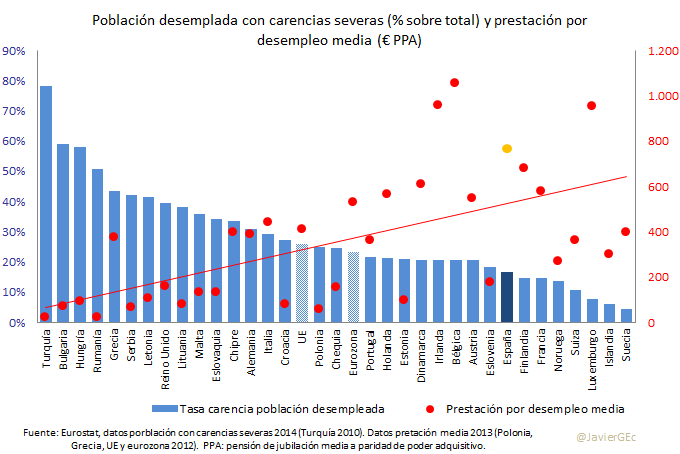
La tasa de pobreza en España es de las más bajas de la UE


Eurostat
Más información...


dissabte, 2 de juliol del 2016

"¡No sea inocente!"
Una película anti-odio de 1947 válida para 2016


OPEN CULTURE.- If you aren’t seriously disturbed, even alarmed, that we in the U.S. have a presidential candidate from a major political party who succeeds by whipping up xenophobic fervor and telling us the country must not only reinstitute torture, but must do “the unthinkable”… well…. I don’t really know what to say to you. Perhaps more symptom than cause of a global turn toward tribal hatred, the GOP candidate has lent his name to a phenomenon characterized by cultish devotion to an authoritarian strongman, serial falsehood, and easy, uncritical scapegoating. We needn’t look far back in time to see the historical analogues, whether in the early 20th century, at the end of the 19th, or during any number of historical moments before and after.

We also needn’t look very far back to find a history of resistance to authoritarian bigotry, and not only from Civil Rights campaigners and leftists, but also, as you can see above, from the U.S. War Department. In 1947, the Department released the short propaganda film, “Don’t Be a Sucker!”, aimed at middle-class American Joes. Shot at Warner Studios, the film opens with some typical noirish crime scenarios, complete with convincingly noir lighting and camera angles, to visually set up the character of the “sucker” who gets taken in by sinister but seductive characters—“people who stay up nights trying to figure out how to take away” what the everyman has. What do naïve potential marks in this analogy have to lose? American plenty: “plenty of food, big factories to make things a man can use, big cities to do the business of a big country, and people, lots of people.”

“People,” the narrator says, working the farms and factories, digging the mines and running the businesses: “all kinds of people. People from different countries with different religions, different colored skins. Free people.” Is this disingenuous? You bet. We’re told this aggregate of people is “free to vote”—and we know this to be largely untrue in practice for many, necessitating the Voting Rights Act almost twenty years later. Free to “pick their own jobs”? Employment discrimination, segregation, and sexism effectively prevented that for millions. But the sentiments are noble, even if the facts don’t fully fit. As our average Joe wanders along, contemplating his advantages, he happens upon a reactionary streetcorner demogague haranguing against foreigners, African-Americans, Catholics, and Freemasons (?) on behalf of “real Americans.” Sounds plenty familiar.

The voice of reason comes from a naturalized Hungarian professor who witnessed the rise of Nazism in Berlin and who explains to our everyman the strategy of fanatics and fascists—divide and rule. “We human beings are not born with prejudices,” says the wise professor, “always they are made for us. Made by someone who wants something. Remember that when you hear this kind of talk. Somebody’s going to get something out of it. And it isn’t going to be you.” The remainder of the film mostly consists of the Hungarian professor’s recollections of how the Nazis won over ordinary Germans.
Seguir leyendo...

Getafe marca con perfil homófobo a los varones heterosexuales, delgados, blancos y católicos

Cuando el responsable de un delito -de odio racial, homofobia, violación, robo...- deja de ser una persona concreta y la presunción de culpabilidad se transfiere a todo un colectivo se produce la quiebra del Estado de Derecho. De ahí a marcar a los 'sospechosos' con una estrella o un triángulo sólo hay un paso.


ABC.- El Ayuntamiento de Getafe aprobará este miércoles una moción a propuesta de todos los grupos, excepto del PP, que establece que el perfil de la persona homófoba es el de un «varón, heterosexual, delgado, blanco y de la fe mayoritaria»; es decir, la católica. Este «Manifiesto por el día internacional del orgullo LGTBI+», redactado por los colectivos UC3M LGTB+, Colegas Getafe y Gaytafe LGTBI+, contará con el apoyo del PSOE (la alcaldesa, Sara Hernández, es también líder de los socialistas madrileños), Izquierda Unida, Ahora Getafe (marca municipal de Podemos) y Ciudadanos.

El PP es el único grupo que votará en contra. En un comunicado recrimina el apoyo del resto de ediles a un texto «cargado de sectarismo, que discrimina a la población por motivos como la apariencia física, el nivel de renta económica o las creencias religiosas».

El texto, al que ha tenido acceso ABC, defiende otras reivindicaciones, como la igualdad de todos los ciudadanos o los derechos de los refugiados/as LGTB+;pero, a renglón seguido, aseguran que existe la «pirámide social de la discriminación», en cuya cúspide se encuentra «el hombre blanco, heterosexual y cisexual (aquel que no es transexual)».

La descripción no termina ahí, pues se dan mas detalles: el homófobo, según esta tesis, es de «clase media o alta, sin diversidad funcional, joven y delgado. Incluso perteneciente a la fe mayoritaria», en referencia al catolicismo.


Recuperar la ambivalencia


Alice Dreger, the historian of science, sex researcher, activist, and author of a much-discussed book of last year, has recently called attention to the loss of ambivalence as an acceptable attitude in contemporary politics and beyond. “Once upon a time,” she writes, “we were allowed to feel ambivalent about people. We were allowed to say, ‘I like what they did here, but that bit over there doesn’t thrill me so much.’ Those days are gone. Today the rule is that if someone — a scientist, a writer, a broadcaster, a politician — does one thing we don’t like, they’re dead to us.”

I’m going to suggest that this development leads to another kind of loss: the loss of our ability to work together, or better, learn from each other, despite intense disagreement over certain issues. Whether it’s because our opponent hails from a different political party, or voted differently on a key referendum, or thinks about economics or gun control or immigration or social values — or whatever — in a way we struggle to comprehend, our collective habit of shouting at each other with fingers stuffed in our ears has reached a breaking point.

It’s time to bring ambivalence back.
Seguir leyendo....


¿Y si 2016 tampoco batiera el récord de temperatura de 1998?


Por fin la Agencia Estatal de Meteorología ha publicado, sin publicidad y sólo para entendidos, la temperatura media en España en el trimestre de la primavera de 2016, marzo-abril-mayo. Como se observa en la figura, la temperatura de esta primavera ha sido más bien fría, algo por encima de los 13 grados. También, como se observa en la figura, desde hace 20 años la evolución de la temperatura media no muestra una tendencia al alza, a pesar de lo que diga la propaganda. ANTÓN URIARTE


PLAZA MOYUA.- Roy Spencer en su blog:

Record Warm 2016? What a Difference One Month Makes

Con el rápido enfriamiento ahora en curso de la temperatura global media troposférica, mi anterior predicción de un año récord en las medidas de los satélites para 2016 parece … bueno … prematura.

Básicamente, si las anomalías (las temperaturas) se mantienen por debajo del valor de 0,34ºC de junio, 2016 no será un año récord.

Significado. Si eso ocurre, la “pausa” en el calentamiento global según lo miden los satélites alcanzará casi seguro los 20 o 21 años. Porque el Pacífico se pondrá muy probablemente en modo La Niña. Y en ese caso quedarán dos opciones.

1) Los satélites miden mal.

2) Los satélites miden bien y los modelos climáticos son una caca. Lo que querría decir que el cuento del Calentamiento Global Acojonante es … ¡un cuento!


El aburrimiento puede llevar al extremismo político


New research published in the European Journal of Social Psychology has found a link between boredom and political extremism.

“Boredom puts people on edge: It makes them seek engagements that are challenging, exciting, and that offer a sense of purpose. Political ideologies can aid this existential quest,” wrote Wijnand A.P. Van Tilburg of King’s College London and Eric Igou of the University of Limerick in their study.

The researchers’ previous study found that boring activities can trigger a sense of meaninglessness in people, along with a corresponding desire to “reinject meaningfulness in their lives.”

“Boredom motivates people to alter their situation and fosters the engagement in activities that seem more meaningful than those currently at hand,” van Tilburg and Igou explained in their new study. Their research suggests that adopting a more extreme political ideology is one way that people reinject meaningfulness into a boring situation.
Más...


divendres, 1 de juliol del 2016

El franquismo sobrevivirá mientras viva el antifranquismo, que todavía sueña con ganar la guerra civil

El franquismo político e institucional murió con la Constitución de 1978. Pero el antifranquismo, no. Esa paradoja explica que el franquismo sobreviva, más allá de los diminutos panteones de la extrema derecha, en el antifranquismo perenne, que todavía sueña con ganar la guerra civil.

Los hinchas de Podexit atribuyen su fracaso electoral el 26-J a los viejos 'fachas', y piden aplicarles la ley del paredón. Se equivocan otra vez. La culpa de su derrota no es del senilismo sino de su antifranquismo redivivo, anacrónico y revanchista.

El franquismo, niños, sólo vive entre vosotros y morirá definitivamente el día en que muera el último antifranquista rezagado.


Los abuelos españoles han salvado a sus nietos porque recuerdan la Guerra Civil

'La efebocracia en boga entraña la creencia en una superioridad moral de los jóvenes que no sólo ha sido contestada en las urnas, sino también en la filosofía, la literatura y la historia. De las fábulas de Esopo al senado romano (senado en latín viene a significar reunión de viejos), la civilización la han construido los consejos de los prudentes y la han defendido los músculos de los guerreros. Por supuesto, en cada tribu el relato custodiado por el sanedrín es diferente, y así como los abuelos británicos han traicionado sin querer a sus nietos porque votaron movidos por el recuerdo de una isla imperial, los abuelos españoles han salvado a los suyos de una amenaza que no necesitan exagerar, porque guardan memoria guerracivilista de su triste certeza. No es que a los viejos les guste la corrupción; no es que les embargue una nostalgia del franquismo que se consuelan con el PP; es que la experiencia les ha persuadido de que no existen los inmaculados, y a cambio han aprendido a ponderar el mal menor entre el asco y la ruina. Tampoco Carmena es una niña, y quizá sea eso lo mejor de su gestión'. | JORGE BUSTOS
Seguir leyendo...


Será más bien que no les votaron por miedo a lo viejo: el frentepopulismo, 'el pueblo unido jamás será vencido', la demagogia, el matonismo...


110 premios Nobel acusan a Greenpeace de "crimen contra la humanidad" por su oposición a los transgénicos


Los ecologistas son muy propensos a envolverse en el manto de la ciencia cuando consideran que conviene a sus intereses, como en el caso del cambio climático, y a ignorarla por completo cuando no lo hace, como es el caso de los transgénicos. Pero ahora tendrán más complicado hacerlo. Más de un centenar de premios Nobel, en el momento de escribir estas lineas,han firmado una dura carta abierta en la que exigen a Greenpeace que cese en su oposición a los transgénicos en general, y más en concreto al arroz dorado.

La carta recuerda que, cada año, entre 250.000 y medio millón de niños en los países pobres se quedan ciegos por falta de vitamina A, y la mitad de ellos mueren de esa enfermedad menos de un año después. Sumando niños y adultos, UNICEF calcula que mueren por esta enfermedad entre uno y dos millones de personas cada año. Esta enfermedad podría prevenirse gracias a un organismo transgénico, el llamado arroz dorado.

A finales de los años 90, dos científicos europeos, Ingo Potrykus y Peter Beyer, desarrollaron una variedad de arroz –un alimento en el que se basa la dieta en muchos países pobres– que incluía entre sus nutrientes la provitamina A o betacaroteno, un compuesto químico que nuestro cuerpo transforma en vitamina A, gracias al uso de genes provenientes de bacterias y otras plantas, como el maíz o los narcisos. Lo llamaron arroz dorado por su color, por otra parte muy apropiado para hacer una paella. Aunque originalmente su creación contenía un porcentaje demasiado pequeño de provitamina, con el paso de los años se ha mejorado hasta conseguir que 144 gramos de este arroz basten para ingerir la dosis diaria necesaria en una dieta sana.
Seguir leyendo...


El presidente checo reclama un referéndum sobre la pertenencia a la UE y a la OTAN


The seeds of European disconent are spreading. One week after Britain voted to separate amicably with the EU, the president of the Czech Republic, Milos Zeman, called for a referendum on his country’s membership in the EU and NATO. Demonstrating a shocking grasp of what democracy truly is, while Zeman wants to remain in both organizations, he wants the public to have a chance to "express themselves" something which sends a spike of terror through the hearts of all unelected Brussels bureaucrats.

Meanwhile, support for the EU is waning in the central European country. In April, a poll conducted by the CVVM institute showed that just 25% of the population is satisfied with their membership in the bloc, as cited by Reuters. Twelve months earlier, that figure had stood at 32%. And so, following on Britain’s vote to exit the EU, Zeman now wants to give the Czech public the chance to decide their own future, as skepticism about the merits of remaining in the bloc continues to rise.

“I disagree with those who are for leaving the European Union,” Czech Radio quoted Zeman as saying on Thursday evening, according to Reuters. “But I will do everything for them to have a referendum and be able to express themselves. And the same goes for a NATO exit too,” he added.
Seguir leyendo...


Bruselas autoriza a Renzi a dar liquidez a la banca italiana


THE WALL STREET JOURNAL.- The European Commission on Sunday authorized Italy to use government guarantees to provide liquidity support to its banks, a spokeswoman said, disclosing the first intervention by a European Union government into its banking system following the U.K. vote to leave the EU.

(...)

Italian banks have lost more than half of their market capitalization since the beginning of the year, as investors fret about some EUR360 billion in bad loans still logged on their balance sheets. That drop in market value compares to an average decline of less than one third for European lenders.

Some Italian banks have seen their shares plummet by some 75% in the first half of the year.

A person familiar with the Italian government’s plans said the cabinet of Prime Minister Matteo Renzi hoped to use a liquidity backstop to contain investor panic, which could result in a run on deposit and affect banks’ liquidity.

The liquidity support provides a temporary cushion for Italian banks. But it doesn’t solve the broader issue of how to raise sufficient capital to sustain writedowns of loan portfolios gone bad.
Seguir leyendo...


El Constitucional austríaco invalida las elecciones presidenciales que ganó el candidato ecologista


Austria's highest court has annulled the result of the presidential election narrowly lost by the candidate of the far-right Freedom Party.

The party had challenged the result, saying that postal votes had been illegally and improperly handled.

The Freedom Party candidate, Norbert Hofer, lost the election to the former leader of the Greens, Alexander Van der Bellen, by just 30,863 votes or less than one percentage point.

The election will now be re-run.

Announcing the decision, Gerhard Holzinger, head of the Constitutional Court, said: "The challenge brought by Freedom Party leader Heinz-Christian Strache against the 22 May election... has been upheld."

He added: "The decision I am announcing today has no winner and no loser, it has only one aim: to strengthen trust in the rule of law a

nd democracy."

Mr Hofer said he was pleased that the court had taken "a difficult decision", adding: "I have great trust in the rule of law." What were the complaints?

In two weeks of hearings, lawyers for the Freedom Party argued that postal ballots were illegally handled in 94 out of 117 districts.

It alleged that thousands of votes were opened earlier than permitted under election rules and some were counted by people unauthorised to do so.

The party also claimed to have evidence that some under-16s and foreigners had been allowed to vote.

In its ruling, the court said election rules had been broken in a way that could have influenced the result.

But it said there was no proof the count had been manipulated.
Leer más...

Elon Musk está equivocado. No vivimos en una simulación


El fundador de SpaceX y Tesla Motors, Elon Musk, sostiene que solo hay "una posibilidad entre miles de millones" de que vivamos de verdad y no en una simulación de computadora."En 40 años hemos pasado del 'Pong' a masivos juegos en línea con millones de jugadores simultáneos y en 3D, y cada año se mejoran. Pronto tendremos la realidad virtual, la realidad aumentada". Según Elon Musk, en un futuro "los juegos llegarán a ser indistinguibles de la realidad", lo que en su opinión no se trata de un hecho negativo. "O vamos hacia la creación de simulaciones que sean indistinguibles de la realidad, o la civilización dejará de existir".

"Una manzana simulado no puede alimentar a nadie", le responden un filósofo, Riccardo Manzotti, y un científico cognitivo, Andrew Smart:

The key question is what are simulations made of? Or, if you are more poetically inclined, what is the stuff that dreams are made of? Simulations are things that we use to talk or to think about other things. In this respect, they do not step out of Musk’s base reality. They are still base reality. They are made of the same stuff everything else is made of.

For instance, a 10-inch neoprene model of Mount Everest is still an object, albeit an object that is used to refer to a much bigger object. A flight simulator is a physical thing used to refer to real planes. A dynamic simulation on a computer of the galaxy is yet another object made of rather complex networks of electronic gates and devices cleverly connected. It is a dynamic object we use to refer to another object. But nowhere do we meet a pure simulation that is not an object.

The idea that simulations are a sort of immaterial entity that are, despite being dependent on their physical substrate, nonetheless different, is a leftover of the aforementioned belief in a higher—and possibly better—reality. It’s a belief that we have no reason to take seriously. The notion that we may mistake a simulation of the world for the world is both conceptually and empirically flawed.

Conceptually, it is a self-defeating notion—something that if taken to be truth, negates itself. In fact, if, say, simulated water might be a meaningful notion, what would it be made of? It could not be made of real stuff, because if it was, it would no longer be simulated water. However, neither could it be made of simulated stuff, because—that’s the point of being a simulation—there is no such thing as simulated stuff. All we know is physical. All we know belongs, once again, to base reality. Either way, simulated water cannot exist.

Empirically, increasing computational power will not necessarily transform the water of computer games into the wine of a full-fledged simulated world. Making bigger bows and stronger arrows will never lead to an H-Bomb. Sometimes there are conceptual gaps that cannot be bridged by incremental improvements. Living in a simulation is not like building a 1-mile-high tower, which is challenging but possible, but rather like having a planet with a certain mass and no gravity. No amount of technological progress will achieve the latter, no matter what.

Moreover, Musk’s confidence in the development of technology—that massive increases in computational power will transmogrify existing videogames into a real simulated world—is based on the confusion between the ideal notion of simulation, which does not really exist, and the actual thing a simulation is. The ideal notion of simulation is, in turn, based on the notion that there are disembodied minds or a higher level of reality over and above basic reality. This is highly questionable.
Leer en Motherboard el artículo completo.


dijous, 30 de juny del 2016

Sabemos que los británicos votaron en contra de la UE, pero no a favor de qué


THE ECONOMIST.- MANY Brexiteers built their campaign on optimism. Outside the European Union, Britain would be free to open up to the world. But what secured their victory was anger.

Anger stirred up a winning turnout in the depressed, down-at-heel cities of England (see article). Anger at immigration, globalisation, social liberalism and even feminism, polling shows, translated into a vote to reject the EU. As if victory were a licence to spread hatred, anger has since lashed Britain’s streets with an outburst of racist abuse.

Across Western democracies, from the America of Donald Trump to the France of Marine Le Pen, large numbers of people are enraged. If they cannot find a voice within the mainstream, they will make themselves heard from without. Unless they believe that the global order works to their benefit, Brexit risks becoming just the start of an unravelling of globalisation and the prosperity it has created.

The rest of history

Today’s crisis in liberalism—in the free-market, British sense—was born in 1989, out of the ashes of the Soviet Union. At the time the thinker Francis Fukuyama declared “the end of history”, the moment when no ideology was left to challenge democracy, markets and global co-operation as a way of organising society. It was liberalism’s greatest triumph, but it also engendered a narrow, technocratic politics obsessed by process. In the ensuing quarter-century the majority has prospered, but plenty of voters feel as if they have been left behind.

Their anger is justified. Proponents of globalisation, including this newspaper, must acknowledge that technocrats have made mistakes and ordinary people paid the price. The move to a flawed European currency, a technocratic scheme par excellence, led to stagnation and unemployment and is driving Europe apart. Elaborate financial instruments bamboozled regulators, crashed the world economy and ended up with taxpayer-funded bail-outs of banks, and later on, budget cuts.

Even when globalisation has been hugely beneficial, policymakers have not done enough to help the losers. Trade with China has lifted hundreds of millions of people out of poverty and brought immense gains for Western consumers. But many factory workers who have lost their jobs have been unable to find a decently paid replacement.

Rather than spread the benefits of globalisation, politicians have focused elsewhere. The left moved on to arguments about culture—race, greenery, human rights and sexual politics. The right preached meritocratic self-advancement, but failed to win everyone the chance to partake in it. Proud industrial communities that look to family and nation suffered alienation and decay. Mendacious campaigning mirrored by partisan media amplified the sense of betrayal.

Less obviously, the intellectual underpinnings of liberalism have been neglected. When Mr Trump called for protectionism this week, urging Americans to “take back control” (see article), he was both parroting the Brexiteers and exploiting how almost no politician has been willing to make the full-throated case for trade liberalisation as a boost to prosperity rather than a cost or a concession. Liberalism depends on a belief in progress but, for many voters, progress is what happens to other people. While American GDP per person grew by 14% in 2001-15, median wages grew by only 2%. Liberals believe in the benefits of pooling sovereignty for the common good. But, as Brexit shows, when people feel they do not control their lives or share in the fruits of globalisation, they strike out. The distant, baffling, overbearing EU makes an irresistible target.
Seguir leyendo...


Ni hubo pucherazo ni puede haberlo

El objetivo de la izquierda radical es acabar con la democracia liberal. Para ello tiene dos caminos. El primero, ganar las elecciones, ocupar el poder y no abandonarlo hasta haber desmantelado la legalidad constitucional. El segundo, perder las elecciones, denunciar un pucherazo masivo que deslegitime al Estado y provocar el colapso de las instituciones (léase golpe de estado).

Eso es lo que desean hacer ahora los amigos de Podexit, sus confluencias, sus mareas y sus botellones doctrinarios. Y es que los hijos mimados del Estado del Bienestar no toleran la frustración. No es sólo que no sepan perder, es que no pueden perder, ya que la dialéctica materialista de la historia predice su victoria inapelable. Ergo, si pierden es porque les han robado la mayoría, porque ha habido conspiración para el pucherazo. Y eso los legitima para cualquier cosa, incluida la mentira y la violencia.

Las mentiras ya han empezado a circular en progresión geométrica en Twitter y Facebook, pero también en las páginas de medios de comunicación afines al populismo que muestran no tener el más mínimo escrúpulo respecto a la veracidad de lo que publican.

Este es el caso, por ejemplo, de las cartas de los supuestos presidentes de Mesa Ruth Bermúdez Rodríguez y Christian Avilés, que cuentan unas historias kafkianas que sólo pueden ser creídas por mucha gente ignorante del funcionamiento de un colegio electoral pero no por nadie que haya estado una sola vez en una mesa de votación.

En su entrada 'No: el 26J no hubo pucherazo (ni puede haberlo)', David Fernández no sólo desmonta las contradicciones de esas dos cartas sino que ofrece otras de las muchas mentiras que se están publicando para hacer creer que en el 26-J hubo pucherazo. De todas ellas recojo una, especialmente reveladora de que nos encontramos ante un proceso de producción industrial de mentiras. Esta:

Que el fraude electoral ha salido publicado incluso en The New York Times. Si se toman la molestia de consultar la edición original, como lo ha hecho David Fernández, comprobarán que la portada difundida es falsa, es un trucaje de photoshop.


'El mundo no se detendrá'

Declaración de 78 personalidades europeas tras el Brexit


The Brexit vote poses profound questions about the future of the European project. But the world will not stop while Europe works out its future; people will continue to want to come, enemies will continue to plot, civil wars will continue to kill.

Even as we fashion a response to the internal crisis of Europe, we must maintain Europe’s capacity to make an effective foreign policy and to protect Europe’s citizens. Ahead of today’s European Council, we call on European leaders to embrace some core principles moving forward:

Unity is the most essential source of Europe’s strength. In a time of heightened emotion, it is essential to avoid actions that sow division among member states. There are multiple institutional options for forging common European responses. But there can be no two classes of EU membership, where one group decides about the others. This will be the fastest way towards the unraveling of the EU. Forging an effective partnership with Britain on foreign and security policy will always be a core interest of the other European states. European foreign policy cannot be divorced from the needs and desires of the people of Europe. Any initiative for forging cooperation among European states must take their concerns seriously.

The following signatories endorse this statement in a personal capacity:

Joaquin Almunia, former Vice President of the European Commission

Kostas Bakoyannis, Governor of Central Greece

Juraj Bayer, CFO & Member of the Board, ZSE Energia

Erik Berglof, Director, Institute of Global Affairs, London School of Economics

Emma Bonino, former Minister of Foreign Affairs of Italy; former European Commissioner

Stine Bosse, Chairman and Non-Executive Board Member; Adjunct Professor, Copenhagen Business School

Goran Buldioski, Director, Think Tank Fund (TTF); Director, Open Society Initiative For Europe (OSIFE)

Gunilla Carlsson, former Minister for International Development Cooperation, Sweden

Ian Clarkson, Chair, Brightfield Consulting

Lucinda Creighton, former European Affairs Minister, Ireland

Daniel Daianu, Professor of Economics, National School of Political and Administrative Studies, Bucharest

Kemal Dervis, Vice-President and Director of Global Economy and Development, Brookings Institution

Mikolaj Dowgielewicz, Director General and Permanent Representative, European Investment Bank

Andrew Duff, Visiting Fellow, European Policy Centre

Karin Forseke, Co-Chair, Sisters Capital

Jaime Gama, former Foreign Minister of Portugal

Jonas Gahr Støre, Leader of the Labour party; former Foreign Minister, Norway

Carlos Gaspar, Portuguese Institute of International Relations

Teresa Gouveia, former Foreign Minister of Portugal

Beatrice de Graaf, Professor of the History of International Relations and Global Governance, Utrecht University

Djema Grozdanova, Chair, Foreign Affairs Committee, National Assembly of Bulgaria

Antonio Guterres, former United Nations Commissioner for Refugees; former Prime Minister of Portugal

Istvan Gyarmati, Ambassador, International Centre for Democratic Transition

Heidi Hautala, Member of the European Parliament; former Minister for International Development, Finland

Connie Hedegaard, former European Commissioner for Climate Action

Diego Hidalgo, Co-founder of Spanish newspaper El País; Founder of Club de Madrid, CITpax and Founder and Honorary President of FRIDE

Anna Ibrisagic, Senior Partner, ESL & Network; former Member of the European Parliament

Jaakko Iloniemi, former Ambassador

Diana Janse, Senior Foreign Policy Advisor, Moderate Party

Mary Kaldor, Professor, London School of Economics

Ivailo Kalfin, Deputy Prime Minister and Minister of Labour & Social Policy; former Foreign Minister

Claude Kandiyoti, CEO, Krest Real Estate Investments

Piia-Noora Kauppi, Managing Director, Federation of Finnish Financial Services

Roderich Kiesewetter, Member of the Bundestag

David Koranyi, Director, Eurasian Energy Future Initiative, Atlantic Council

Brigid Laffan, Director, Robert Schuman Centre for Advanced Studies, European University Institute

Pascal Lamy, Honorary President, Notre Europe; former Director-General of the WTO; former EU Commissioner

Mark Leonard, Director, European Council on Foreign Relations

Sonja Licht, President, Belgrade Fund for Political Excellence

Maria Livanos Cattaui, former Secretary-General of the International Chamber of Commerce

Miguel Maduro, Professor and Director, Global Governance Programme at the European University Institute; former Minister

Cristina Manzano, Editor-in-chief, Esglobal

Joseph Mifsud, Director, London Academy of Diplomacy; Professor, University of Stirling

Hedvig Morvai, Executive Director, European Fund for the Balkans

Alina Mungiu-Pippidi, Professor of Democracy Studies, Hertie School of Governance

Dietmar Nietan, Member of the Bundestag

Kalypso Nicolaidis, Professor of International Relations, University of Oxford

Christine Ockrent, Commentator and writer; Presenter of 'Affaires Internationales', France Culture Radio

Andrzej Olechowski, former Foreign Minister

Dick Oosting, CEO, European Council on Foreign Relations

Andres Ortega, Author & journalist; former Director of Policy Planning, Office of the Spanish Prime Minister

Marc Otte, Director General, Egmont Institute; former EU Special Representative to the Middle East Peace Process

Cem Özdemir, Member of the Bundestag

Zaneta Ozolina, Professor, University of Latvia;

Katarzyna Pelczynska-Nalecz, Ambassador of Poland to the Russian Federation

Ruprecht Polenz, former Chairman of the Committee on Foreign Affairs of the Bundestag

Charles Powell, Director, Real Instituto Elcano

Andrew Puddephatt, Director, Global Partners & Associated Ltd.

Norbert Roettgen, Chairman of the Committee on Foreign Affairs of the Bundestag

Albert Rohan, former Ambassador

Jan Royall, Member of the House of Lords

Adam Daniel Rotfeld, former Foreign Minister of Poland

Nicolò Russo Perez, International Affairs Programme, Compagnia di San Paolo

Wolfgang Schuessel, former Federal Chancellor of Austria

Narcis Serra, President, IBEI

Javier Solana, former EU High Representative for the Common Foreign and Security Policy & Secretary-General of the Council of the EU; former Secretary General of NATO

George Soros, Founder and Chairman, Open Society Foundations

Andris Strazds, Advisor, Bank of Latvia

Ion Sturza, Founder & Chairman, Fribourg Capital

Hannes Swoboda, former President of the Progressive Alliance of Socialists and Democrats, European Parliament

Reka Szemerkenyi, Ambassador of Hungary to the United States

Anna Terron Cusi, President, InStrategies

Erkki Tuomioja, former Foreign Minister of Finland

Constantijn van Oranje, Chairman, Start-up Fest Europe; Director for Digital Diplomacy and Macro Strategy, Macro Advisory Partners

Jordi Vaquer, Director, Open Society Initiative for Europe

Andre Wilkens, Author

Stelios Zavvos, Founder and CEO of Zeus Capital Management, Chairman of the Board of Solidarity Now organization

Samuel Zbogar, EU Representative to Kosovo; former Foreign Minister


Vuelve el debate en la UE sobre más o menos Europa


POLITICO.- While there was a consensus that the Brexit vote is a “wake-up call,” and a mixture of varying sadness over the outcome and anger with Cameron, there was less clarity and much debate about how the EU should respond.

“The next weeks will be decisive,” French President François Hollande said. “Europe must show its solidity, its solidarity, its capacity to propose initiatives for and with Europeans.”

The early blueprints, which will sound familiar to anyone who has followed European politics over the past 30 years, can be abridged to “more versus less Europe.”

Europe’s center-left, in what could be mistaken for a case study in Pavlovian conditioning, has responded to the British whistle by dusting off its plan for a more federalist Europe, replete with a common budget and much deeper political integration.

Just a day after the result came in, the Socialist foreign ministers of France and Germany presented a paper sketching out their vision for “further steps in the direction of a political union in Europe,” including the introduction of a “fiscal capacity” by 2018 to invest in the Union’s battered economies.

Such ideas, and the fiscal transfers they would entail, are anathema to most of Europe’s conservatives. The center-right is pushing in the opposite direction: “national solutions where possible; European solutions, where necessary,” said Dutch Prime Minister Mark Rutte.

“This is not a time to resort to extremist thinking or to get bogged down in ideological discussions about a superstate versus nation states,” he said after Tuesday’s summit dinner. “Our focus should be on practical cooperation that will lead to a stronger and better Europe.”

In countries with strong anti-EU movements, a group that now includes most of the Continent, the political appetite for deeper integration has evaporated.

That suggests a more pragmatic approach will prevail. Instead of trying to restructure the EU root and branch, a task that would require both unanimity and referendums in a number of countries, several of the bloc’s leaders said after Wednesday’s deliberations they would work within the confines of what already exists. Their goal is to find common solutions to address issues from economic stagnation to migration to security.
Seguir leyendo...


******
Un grupo de jóvenes increpa a un hombre extranjero en un tranvía de Manchester, mientras le gritan que abandone el Reino Unido

dimecres, 29 de juny del 2016

Así desmontó Borrell a Junqueras (Vídeo)

Hacer del Brexit una oportunidad [Henry Kissinger]


Too much of the Europe of today is absorbed in management of structural problems rather than the elaboration of its purposes. From globalization to migration, the willingness to sacrifice is weakening. But a better future cannot be reached without some sacrifice of the present. A society reluctant to accept this verity stagnates and, over the decades, consumes its substance.

Inevitably a gap arises between the institutions and their responsibilities, which accounts for increasing populist pressures. The deepest challenge to the EU is not its management but its ultimate goals. In a world in which upheavals based on conflicting values span the continents, a common act of imagination by Europe and its Atlantic partners is badly needed.

Instead, European leadership is now faced with an unexpected challenge. Under the terms of its charter, the EU is obliged to negotiate with a principal member over the terms of withdrawal. Britain will want to maintain extensive ties with Europe while lifting or easing the constraints of its many legislative and bureaucratic requirements. The EU leadership has almost the opposite incentive. It will not wish to reward Britain’s Leave majority by granting Britain better terms than it enjoyed as a full member. Hence a punitive element is likely to be inherent in the EU bargaining position.

Many of us who have grown up with and admired the vision of European unity hope that the EU will transcend itself, by seeking its vocation not in penalizing the recalcitrant but by negotiating in a manner that restores the prospects of unity. The EU should not treat Britain as an escapee from prison but as a potential compatriot.

Punishing the U.K. will not solve the question of how to operate a common currency in the absence of a common fiscal policy among countries with disparate economic capacities, or of how to define a union whose ability to achieve common political strategies lags fundamentally behind its economic and administrative capacities.

By the same token, Britain needs to put forward the concept of autonomy for which its people voted in a manner that embraces ultimate cooperation. Britain and Europe together must consider how they might return, at least partially, to their historical role as shapers of international order.

In recent decades, Europe has retreated to the conduct of soft power. But besieged as it is on almost all frontiers by upheavals and migration, Europe, including Britain, can avoid turning into a victim of circumstance only by assuming a more active role. These vistas cannot yet be discussed at a geopolitical level, but the EU’s leaders should be able to form discrete and discreet panels for exploring them. In this manner, the Leave vote can serve as a catharsis. | HENRY KISSINGER

Leer el artículo completo, aquí (The Wall Street Journal)


Descubren el primer cáncer contagioso que puede saltar entre las especies

Se estudiaron colonias enfermas de mejillones de cerca de Vancouver y berberechos y almejas de la costa de España


THE WASHINGTON POST.- The first contagious cancer was discovered in the 1990s, when researchers studying Tasmanian devils noticed that the fierce marsupials were perishing from ugly facial tumors. Eventually, they identified two cancer cell lines that were causing the disease. Meanwhile, scientists working with dogs found that canines on every continent have been suffering from a sexually transmitted tumor for hundreds of years.

Goff and his colleagues found a third example of this phenomenon last year in soft shell clams living along the Atlantic coast. A colleague working at the Marine Biological Laboratory at Woods Hole, Mass., asked him to come take a look at her dying clams, which she thought were suffering from a virus. Instead, they were being killed by a form of bivalve leukemia.

"It was really wild," Goff told The Washington Post at the time. "It was not what we were expecting."

Cockles (Cerastoderma edule) collected in Galicia, Spain. They are one of three new species that suffer from contagious cancer. (David Iglesias via Nature) But the discovery got him wondering whether transmissible cancers might be more common than anyone realized. So he set about collecting specimens from sick bivalve colonies on opposite sides of the world: mussels from near Vancouver and cockles and golden carpet shell clams on the coast of Spain. All three species were dying from cancer, he found. And all three of the cancers were genetically different from their hosts (the cockles suffered from two distinct strains).
Leer más...


Lo que ocurrió en Sheffield explica por qué Gran Bretaña optó por el Brexit

El voto de los obreros empobrecidos por la globalización, desilusionados con el laborismo, se fueron al UKIP


Like the rest of the country, the city voted in favor of Brexit by a paper-thin margin: just 51% voted to Leave, with only 6,000 votes separating the Brexit and Remain camps. And right up until the eve of the result, Sheffield was expected to vote Remain – as was the UK as a whole.

To understand what happened here, we need to go back to April 2014, when UKIP leader Nigel Farage launched his campaign for the European Parliament elections in central Sheffield. For some, this seemed bizarre. Many had seen his party as an electoral threat primarily to the Conservatives. But Sheffield is a long-time Labour stronghold, in a Labour-dominated region. It hardly looked like fertile territory for a party nipping at the Conservatives’ heels. What was Farage up to?

At the launch, he made his intentions clear. Labour’s northern strongholds were very much in UKIP’s sights. Political scientists Rob Ford and Matt Goodwin later revealed that older, working class voters – who had long formed the core of Labour’s support – were becoming disillusioned. They felt “left behind” by social and economic change, and ignored by the political establishment (not least on concerns over rapid immigration from the EU). As a result, many were thinking of shifting to UKIP.
Leer más...